
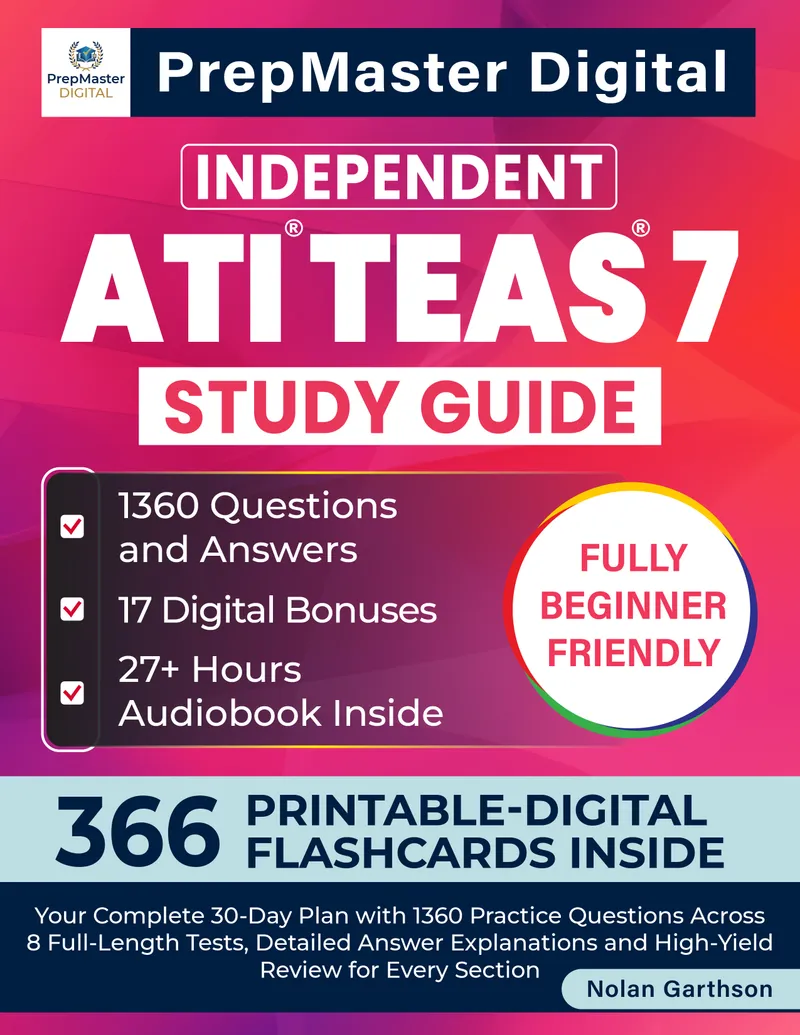
ATI TEAS 7 Study Guide 2027-20281,360 practice questions with explained answers · 366 flashcards · 27.7-hour audiobook · AI tutor
Complete digital study edition
Your Complete 30-Day Plan with 1360 Practice Questions Across 8 Full-Length Tests, Detailed Answer Explanations and High-Yield Review for Every Section
Pass with the PrepMaster Method. Every attempt covered.
Study guide, practice questions with explained answers, flashcards, audiobook, bonuses and an AI tutor. If you don't pass, our Retake Promise gives you the latest edition of everything, free, until you pass.
1. Measure
Take the free readiness test and see where you stand before you study.
2. Study
Work through one complete kit built on your exam's official outline, with the audiobook for the commute.
3. Ask
Stuck on a topic? The AI tutor answers from the chapters of your guide (5 free questions included).
4. Retake Promise
Didn't pass? Send us your official result and we give you everything, updated, free, for your next attempt.
5 sample ATI TEAS 7 questions from the guide
Taken from the practice tests in the book, with the answer and the explanation the guide gives.
1. During practice, a student skims a passage about the history of hospital triage systems. After reading the first sentence of each paragraph and the final paragraph, the student still cannot state the main idea. What should the student do next according to a sound reading strategy?
- A. Reread the entire passage slowly from beginning to end before looking at any question
- B. Read the first paragraph and identify the job it does, then read each later paragraph and note what it adds before forming a summary that covers all of them
- C. Move to the questions and read them first, because they will reveal which paragraph contains the main idea
- D. Scan the passage for all proper nouns, dates, and numbers to infer the subject from those details
Show the answer
Correct answer: B. After an unsuccessful skim, the fallback is to work through the passage paragraph by paragraph, identifying the function of each paragraph before forming a summary that accounts for all of them. Rereading the whole passage or starting with the questions does not provide the structural overview the fallback method is designed to produce.
2. Which equivalent form correctly shows that the subtraction sign in 10 - 3 + 2 applies only to the 3?
- A. 10 - (3 + 2)
- B. 10 + 3 - 2
- C. 10 + (-3) + 2
- D. 10 - 3 - 2
Show the answer
Correct answer: C. The minus sign is the sign of the 3, so the terms are 10, -3, and +2. Rewriting as 10 + (-3) + 2 preserves that meaning, while 10 - (3 + 2) incorrectly groups -3 and +2 as -5.
3. Researchers compare two groups of older adults: one group takes a daily omega-3 supplement, the other takes a placebo. The supplement group also attends a weekly exercise class, while the placebo group does not. In this study, the weekly exercise class is best classified as what?
- A. The dependent variable
- B. A controlled variable
- C. A confounding variable
- D. The independent variable
Show the answer
Correct answer: C. The exercise class differs between the two groups along with the supplement, so it offers an alternative explanation for any observed differences. A variable that changes together with the independent variable and can affect the result is a confounding variable.
4. A neutral magnesium atom becomes a Mg2+ ion. Which change accounts for this transformation?
- A. It lost two neutrons.
- B. It lost two electrons.
- C. It gained two electrons.
- D. It gained two protons.
Show the answer
Correct answer: B. A cation forms when an atom loses electrons, leaving more protons than electrons and giving a net positive charge. Gaining or losing protons would change the element, and losing neutrons affects only the isotope.
5. A patient sustains blunt trauma to the anterior chest. The medical team must evaluate the organs within the thoracic cavity. Which group of organs should be assessed?
- A. Kidneys, ureters, and bladder
- B. Heart, lungs, esophagus, and trachea
- C. Spleen, pancreas, and small intestine
- D. Stomach, liver, and gallbladder
Show the answer
Correct answer: B. The thoracic cavity contains the heart, lungs, esophagus, and trachea. The organs listed in the other options are located in the abdominopelvic cavity, which lies inferior to the diaphragm.
Top scorers know the secrets. This guide hands them to you.
You need high-yield focus and realistic practice. This guide delivers both: concentrated review of every domain, then eight full-length practice exams built to the real exam's format and difficulty.
Everything you get
One purchase unlocks everything below, with no subscription. The only optional extra is the unlimited AI tutor upgrade. Here is exactly what unlocks the moment you buy, and how each part helps you.
1,360
practice questions — every answer explained
366
digital flashcards, ready to drill
~27.7h
of professional audio narration
14
downloadable study tools
Complete audiobook — about 27.7 hours
The entire book, professionally narrated. Stream it in your browser or download the MP3s and study on the commute, at the gym, or on a break — so the material sinks in even when you can't sit down to read.
AI Study Tutor — ask this book anything
A tutor that has read this exact book: ask about any topic, get an answer grounded in its own chapters, right on your access page. 5 questions are included free with your purchase, and the tutor upgrade gives you unlimited questions (fair use: 100 a day — write to us and we lift it).
- “Explain this topic in simple words, with an example.”
- “I got this question wrong: why is the right answer correct?” (paste the question)
- “Which chapter should I review for my weakest topic?”
30-Day Study Calendar with Daily Tasks
A day-by-day schedule that breaks the entire TEAS 7 prep into 60-minute daily sessions.
High-Yield Topic Checklist by Section
A comprehensive checklist of every concept covered in the book, so you never miss a key point.
Test-Taking Strategy Playbook
Strategies for pacing, eliminating wrong answers and managing stress on test day.
Anatomy & Physiology Memory Palace Starter Kit
A framework to build memorable mental for the 12 body systems.
Formula and Conversion Quick Reference Sheet
All essential math formulas and conversions on one printable sheet.
Vocabulary Root Word Decoder
Break down unfamiliar words by learning common prefixes, suffixes, and roots.
Grammar Rules Cheat Sheet
A concise summary of punctuation, subject-verb agreement, and common usage errors.
Practice Test Answer Tracker (8 Tests)
Grids to log answers, time, and scores for each full-length practice test.
Error Analysis Logbook
A structured template to analyze mistakes and track improvement over time.
Reading Comprehension Passage Strategy Guide
Step-by-step approach to tackling passages and answering inference questions quickly.
Chemistry and Biology Mnemonic Cards
Printable mnemonic Digital flashcards for key science terms and processes.
The 12 Body Systems Rapid Review Cards
Quick-reference cards summarizing the main organs and functions of each system.
Math Word Problem Translation Guide
Turn complex word problems into solvable equations with easy translation rules.
Final Review Weekend Crunch Pack
A condensed summary of the highest-yield topics for last-minute review.
Delivered as a PDF and EPUB you can read on any device, plus downloadable audio and toolkit files. Nothing to install, and your access never expires.
Everything you'll master, chapter by chapter
The complete syllabus of this guide — built on the official exam outline.
Chapter 1: Your 30-Day Roadmap, How to Use This Book for Efficient TEAS 7 Preparation
- ▸ Decoding the TEAS 7 Blueprint, Section Order, Question Counts, and Time Limits
- ▸ Diagnosing Your Starting Point, Which Content Areas Need the Most Attention
- ▸ Building Your 30-Day Calendar from 60-Minute Daily Blocks
- ▸ Making Each Day Count, A Weekly Review and Adjustment Cycle
- ▸ Choosing the Right Practice Mix for Your Target Test Date
Chapter 2: Reading, Finding Meaning in TEAS Passages
- ▸ Skimming, Scanning, and Close Reading, Which to Apply
- ▸ Identifying Main Ideas and Topic Sentences in TEAS Passages
- ▸ Distinguishing Supporting Details, Facts, and Opinions
- ▸ Making Accurate Inferences and Drawing Conclusions
- ▸ Author's Purpose, Tone, and Perspective in Fiction and Nonfiction
- ▸ Following Text Structures, Sequence, Compare-Contrast, Cause, and Problem-Solution
- ▸ Evaluating Arguments, Claims, Evidence, and Author's Assumptions
Chapter 3: Mathematics, From Fundamentals to Data Analysis
- ▸ Fluency with Fractions, Decimals, and Percent Conversions
- ▸ Order of Operations and Integer Rules
- ▸ Ratios, Proportions, and Scale Factors in Context
- ▸ Solving Linear Equations and Inequalities Step by Step
- ▸ Translating Word Problems into Algebraic Expressions
- ▸ Perimeter, Area, Volume, and Geometric Relationships
- ▸ Converting Measurements with Dimensional Analysis
Chapter 4: Scientific Reasoning and Biology, Thinking Like a Life Scientist
- ▸ Reading and Evaluating Experimental Scenarios
- ▸ Designing a Sound Experiment, Hypotheses, Variables, and Controls
- ▸ Cell Theory, Prokaryotes, and Eukaryotes
- ▸ Organelles and Cell Functions at a Glance
- ▸ Membrane Transport, Diffusion, Osmosis, and Active Transport
- ▸ DNA, RNA, and Protein Synthesis
- ▸ Cell Division, Mitosis, Meiosis, and Checkpoints
Chapter 5: Chemistry, Atomic Structure Through Reactions and Solutions
- ▸ Atomic Structure, Ions, and Isotopes
- ▸ Periodic Table Layout and Trends
- ▸ Ionic and Covalent Bonding
- ▸ Formulas and Lewis Structures
- ▸ Reaction Types and Balancing Equations
- ▸ The Mole and Stoichiometric Calculations
- ▸ Solutions, Concentration, and Solubility
Chapter 6: Anatomy and Physiology I, Support, Movement, and Control
- ▸ Anatomical Direction, Planes, and Body Cavities
- ▸ Primary Tissue Types and Their Functions
- ▸ Skeletal System, Bones, Cartilage, Joints, and Repair
- ▸ Muscular System, Muscle Types, Microanatomy, and Contraction
- ▸ Nervous System, Neurons, Impulses, and Synaptic Transmission
- ▸ Brain, Spinal Cord, and Protective Coverings
- ▸ Special Senses, Vision, Audition, Equilibrium, Smell, and Taste
Chapter 7: Anatomy and Physiology II, Transport, Metabolism, Defense, and Excretion
- ▸ Cardiovascular System, Heart Structure and the Cardiac Cycle
- ▸ Blood Vessels, Circulation, and Blood Pressure
- ▸ Lymphatic System and Immune Defenses
- ▸ Respiratory System, Ventilation and Gas Exchange
- ▸ Digestive System, Ingestion Through Absorption
- ▸ Urinary System, Kidneys, Nephrons, and Urine Formation
- ▸ Integumentary System, Skin Structure and Temperature Regulation
Chapter 8: English and Language Usage, Grammar and Clear Expression
- ▸ Building Blocks of Sentences, Phrases and Clauses
- ▸ Parts of Speech and Their Functions
- ▸ Subject-Verb and Pronoun-Antecedent Agreement
- ▸ Verb Tenses, Voice, and Mood
- ▸ Punctuation, Commas, Semicolons, Colons, and Apostrophes
- ▸ Spelling, Capitalization, and Commonly Confused Words
- ▸ Writing Clearly and Concisely, Word Choice and Sentence Revision
Chapter 9: Test-Day Strategy, Pacing, Process of Elimination, and Logistics
- ▸ How the TEAS 7 Is Structured and Timed
- ▸ Pacing Patterns and Time Checkpoints for Each Section
- ▸ Order of Attack, Skipping, Marking, and Returning Strategies
- ▸ Process of Elimination and Making High-Probability Educated Guesses
- ▸ Managing Anxiety and Maintaining Focus Across 209 Minutes
- ▸ The Evening Prior and the Morning Of, A Logistics Checklist
Chapter 10: Retention Science, Making Knowledge Stick with Active Review
- ▸ Spaced Repetition, Scheduling Reviews at the Right Intervals
- ▸ Active Recall, Using Closed-Book Retrieval to Reinforce Learning
- ▸ Mnemonic Strategies for Lists and Processes
- ▸ Interleaving Content, Mixing Sections for Stronger Memory
- ▸ Micro-Review Rounds, Using 5 to 10 Minute Gaps
…plus the full-length practice exams with every answer explained.
How you get everything
No accounts to create, no waiting. Here is exactly what happens after you buy.
Buy securely
Checkout is handled by our payment provider over an encrypted connection. Pay by card in about a minute.
Get an instant email
Seconds after payment, we email you a private access link — no app to download, no signup to complete.
Open everything
Your access page unlocks the full digital edition, audiobook and toolkit. It is yours to keep, with lifetime access.
What readers say · 5/5 from 5 reviews
★★★★★
The TEAS 7 guide for 2026-2027 is incredible! It broke down the complex science and math into easy-to-grasp lessons. Perfect for non-scientists!
★★★★★
I was terrified of the anatomy section, but the visual concept maps in this TEAS 7 guide made it so much easier to understand.
★★★★★
The 14-hour strategy audiobook for the TEAS 7 is a lifesaver. I listened to it constantly and passed with an advanced score!
★★★★★
I love the 1,000+ practice questions! They are fully updated for the new blueprint, so there were zero surprises on test day.
★★★★★
If you are a nursing student, you need this TEAS 7 guide. It's the most comprehensive and modern study system out there!
Retake Promise: you never pay twice
If you don't pass, tell us: we give you the newest edition of everything (the guide, practice questions, flashcards, audiobook, bonuses and the AI tutor), free, for every new attempt until you pass. We also let you know when new editions and new exam guides come out, and you get a personal 50% code on all our other guides to prepare for your next exam. Full terms.
Common questions
Is this an official exam product?
No — this is an independent study guide created to help you prepare. It isn't affiliated with or endorsed by the organization that administers the exam. All names and trademarks belong to their respective owners.
How do I get access after buying?
Immediately. Your private access link arrives by email within seconds of checkout, and it never expires.
What format is everything in?
You get the full guide as a PDF and EPUB, the audiobook as downloadable MP3s, and every study tool as a ready-to-use file. Nothing to install.
What's the difference between the digital and paperback edition?
Same complete guide. The digital edition gives you instant access right here plus the full toolkit. The Amazon paperback ships to you and unlocks the same toolkit with the code printed inside.
Can I get a refund?
Digital guides are delivered instantly, so we don't offer refunds. Instead there is the Retake Promise: if you don't pass, you get everything, updated, free, until you pass, and a personal 50% code on our other guides. Before you buy, try the free readiness test. Full terms of the Retake Promise. Your legal rights are not affected (refund policy).
Related guides
Walk in prepared. Start today.
The complete guide, the practice questions, the audiobook and the full toolkit — unlocked the moment you buy, and yours to keep.
Already own the book? Redeem your code →
PrepMaster Digital is an independent publisher. This guide is not affiliated with or endorsed by the organization that administers the exam. All exam names and trademarks belong to their owners.
$66.99$19.99instant access