
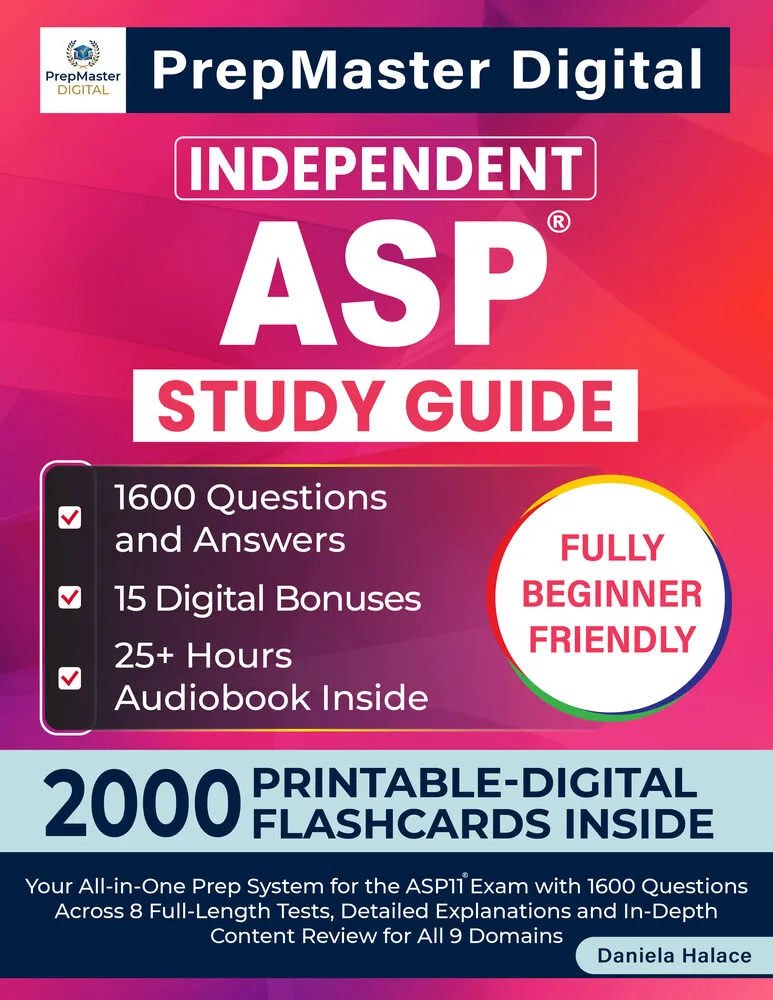
ASP Study Guide 2027-20281,600 practice questions with explained answers · 2,000 flashcards · 30.3-hour audiobook · AI tutor
Complete digital study edition
Your All-in-One Prep System for the ASP11 Exam with 1600 Questions Across 8 Full-Length Tests, Detailed Explanations and In-Depth Content Review for All 9 Domains
Pass with the PrepMaster Method. Every attempt covered.
Study guide, practice questions with explained answers, flashcards, audiobook, bonuses and an AI tutor. If you don't pass, our Retake Promise gives you the latest edition of everything, free, until you pass.
1. Measure
Take the free readiness test and see where you stand before you study.
2. Study
Work through one complete kit built on your exam's official outline, with the audiobook for the commute.
3. Ask
Stuck on a topic? The AI tutor answers from the chapters of your guide (5 free questions included).
4. Retake Promise
Didn't pass? Send us your official result and we give you everything, updated, free, for your next attempt.
5 sample ASP questions from the guide
Taken from the practice tests in the book, with the answer and the explanation the guide gives.
1. An industrial hygienist measures a worker's exposure to a chemical during three tasks: Task A (2 hours at 50 ppm), Task B (3 hours at 30 ppm), and Task C (1 hour at 20 ppm). What is the time-weighted average exposure over the 6-hour period?
- A. 35.0 ppm
- B. 33.3 ppm
- C. 36.7 ppm
- D. 40.0 ppm
Show the answer
Correct answer: A. The time-weighted average is calculated as (2×50 + 3×30 + 1×20) / (2+3+1) = (100+90+20)/6 = 210/6 = 35.0 ppm. Option B, 33.3 ppm, incorrectly uses a simple average of the concentrations without weighting by time.
2. When replacing a V-belt on a motor-driven pump, a JHA includes the step of isolating the electrical supply. What control is specified for this step?
- A. Apply lockout/tagout with a personal lock and hasp, and verify by attempting to start the motor.
- B. Wear insulating gloves and safety glasses.
- C. Disconnect the power cord and store it in a locked cabinet.
- D. Use a remote start button to test the motor.
Show the answer
Correct answer: A. The example in the text explicitly describes this control for electrical isolation during belt replacement.
3. To ensure proper seat depth for a seated worker, the ergonomist applies the two-to-three finger gap rule. This rule describes the gap between which two body parts after adjusting the seat?
- A. Front edge of seat pan and back of knee
- B. Backrest and lower back
- C. Seat cushion and buttocks
- D. Armrest and elbow
Show the answer
Correct answer: A. The rule states that when seated against the backrest, there should be a two- to three-finger gap between the front edge of the seat pan and the back of the knee to avoid pressure on the underside of the thigh.
4. Which of the following best describes the flash point of a flammable liquid?
- A. The temperature at which combustion becomes self-sustaining after ignition
- B. The temperature at which the liquid ignites spontaneously
- C. The temperature at which the liquid's vapor pressure equals atmospheric pressure
- D. The lowest temperature at which the liquid produces enough vapor to form an ignitable mixture with air that can be ignited by an external source
Show the answer
Correct answer: D. The flash point is the lowest temperature at which a liquid gives off enough vapor to form an ignitable mixture with air that can be ignited by an external source. Option A describes the fire point, B describes the autoignition temperature, and C describes the boiling point.
5. Under 29 CFR 1910.38, the requirement to keep a written Emergency Action Plan at the workplace does not apply when:
- A. The employer has ten or fewer employees
- B. The plan is stored electronically on a password-protected server
- C. The facility has a fire suppression system
- D. The plan is reviewed annually
Show the answer
Correct answer: A. OSHA allows employers with 10 or fewer employees to communicate the plan orally, thus the written plan is not required to be kept at the workplace.
You are in the exam room. The first question requires no memorized formula, only a sharp decision.
What You Will Master, Domain by Domain
- Mathematical Calculations: Apply physics, chemistry and statistics, not memorize equations. Worked examples for every calculation type.
- Safety Programs and Concepts: Build, evaluate and improve programs. Decision frameworks for hazard analysis and risk assessment.
- Ergonomics: Identify risk factors and design controls using real workplace scenarios, not just definitions.
- Fire Prevention & Protection: Understand fire dynamics, suppression systems and life safety codes through application-focused review.
- Emergency Preparedness and Response: Plan, implement and evaluate emergency response protocols. Scenario-based practice that mirrors incident command.
- Industrial Hygiene & Occupational Health: Solve TWA, STEL and exposure limits with confidence. Biological hazard controls included.
- Environmental Management: Navigate EPA, DOT and sustainability frameworks. Modern topics like ESG and Total Worker Health covered.
- Training, Education & Communication: Design effective safety training and measure its impact. Adult learning principles applied.
- Legal: Distinguish legal duties, ethical obligations and regulatory compliance. Landmark cases explained.
YOUR 15 RESOURCES, INSIDE
- The Complete Audiobook: The entire book narrated in a clear, steady voice.
- 1000 Term Flashcards: Every must-know term, definition, and piece of vocabulary on one side, its plain-English meaning on the other.
- 1000 Concept Flashcards: Application-style question-and-answer cards that drill HOW the concepts work.
- ASP11 Domain Weight Tracker (Fill-in Spreadsheet): Plan your study hours proportionally to each domain's exam weight so you never over- or under-prepare.
- Safety Management Systems Decision Tree (One-Page Reference): Instantly identify the correct SMS approach.
- Formula Application Worksheet (Worked Examples): Master the 15 most-tested calculations by solving step-by-step problems that mirror the new application-focused exam.
- Ergonomics Assessment Checklist (Job Site Ready): Conduct a thorough workplace ergonomic evaluation using this checklist of 30+ risk factors.
- Fire Protection Quick Reference Card (Printable): Memorize fire classifications, suppression agents and detection systems at a glance, no more flipping pages.
- Emergency Response Protocol Cards (Set of 10): Drill the critical steps for chemical spills.
- Industrial Hygiene Calculations Workbook (Fill-in Exercises): Practice TWA, STEL, ceiling limit and ventilation calculations until they become second nature.
- Environmental Compliance Checklist (Regulatory Ready): Ensure your facility meets EPA, OSHA and DOT requirements with this domain-by-domain compliance self-audit.
- Training Communication Scriptbook (10 Scenarios): Deliver impactful safety training sessions using ready-to-adapt scripts for toolbox talks.
- Law and Ethics Primer (Key Cases and Principles): Quickly distinguish between ethical dilemmas.
- 90-Day Study Plan & Progress Tracker (Personalized)
- Exam Day Readiness Checklist (Last-Minute Review)
Open the first practice test today.
Associate Safety Professional, ASP, and ASP11 are trademarks of their respective owners. This is an independent, unofficial publication and is not affiliated with or endorsed by, or sponsored by any trademark owner.
Everything you get
One purchase unlocks everything below, with no subscription. The only optional extra is the unlimited AI tutor upgrade. Here is exactly what unlocks the moment you buy, and how each part helps you.
1,600
practice questions — every answer explained
2,000
digital flashcards, ready to drill
~30.3h
of professional audio narration
12
downloadable study tools
Complete audiobook — about 30.3 hours
The entire book, professionally narrated. Stream it in your browser or download the MP3s and study on the commute, at the gym, or on a break — so the material sinks in even when you can't sit down to read.
AI Study Tutor — ask this book anything
A tutor that has read this exact book: ask about any topic, get an answer grounded in its own chapters, right on your access page. 5 questions are included free with your purchase, and the tutor upgrade gives you unlimited questions (fair use: 100 a day — write to us and we lift it).
- “Explain this topic in simple words, with an example.”
- “I got this question wrong: why is the right answer correct?” (paste the question)
- “Which chapter should I review for my weakest topic?”
ASP11 Domain Weight Tracker (Fill-in Spreadsheet)
Plan your study hours proportionally to each domain's exam weight so you never over- or under-prepare.
Safety Management Systems Decision Tree (One-Page Reference)
Instantly identify the correct SMS approach, hazard analysis, risk assessment, or program evaluation, with a single flowchart.
Formula Application Worksheet (Worked Examples)
Master the 15 most-tested calculations by solving step-by-step problems that mirror the new application-focused exam.
Ergonomics Assessment Checklist (Job Site Ready)
Conduct a thorough workplace ergonomic evaluation using this checklist of 30+ risk factors.
Fire Protection Quick Reference Card (Printable)
Memorize fire classifications, suppression agents, and detection systems at a glance, no more flipping pages.
Emergency Response Protocol Cards (Set of 10)
Drill the critical steps for chemical spills, fires, medical emergencies, and natural disasters with these pocket-sized cards.
Industrial Hygiene Calculations Workbook (Fill-in Exercises)
Practice TWA, STEL, ceiling limit, and ventilation calculations until they become second nature.
Environmental Compliance Checklist (Regulatory Ready)
Ensure your facility meets EPA, OSHA, and DOT requirements with this domain-by-domain compliance self-audit.
Training Communication Scriptbook (10 Scenarios)
Deliver impactful safety training sessions using ready-to-adapt scripts for toolbox talks, orientations, and drills.
Law and Ethics Primer (Key Cases and Principles)
Quickly distinguish between ethical dilemmas, legal duties, and regulatory compliance with a concise case-law summary.
90-Day Study Plan & Progress Tracker (Personalized)
Customize your study schedule by domain, track completed practice tests, and measure your readiness week by week.
Exam Day Readiness Checklist (Last-Minute Review)
Review the top 50 concepts, logistics, and mental-prep steps the morning of your exam so nothing is left to chance.
Delivered as a PDF and EPUB you can read on any device, plus downloadable audio and toolkit files. Nothing to install, and your access never expires.
Everything you'll master, chapter by chapter
The complete syllabus of this guide — built on the official exam outline.
Chapter 1: Your ASP11 Exam Prep Roadmap: How to Use This Guide for Maximum Efficiency
- ▸ Understanding the ASP11 Blueprint Shift from Memorization to Application
- ▸ Assessing Your Starting Point: Diagnostic Self-Evaluation
- ▸ Study Plans for Different Timeframes (4-Week, 8-Week, 12-Week)
- ▸ Test-Taking Strategies for the Application-Focused Exam
- ▸ Managing Exam-Day Logistics and Anxiety
Chapter 2: Mastering the Math: Calculations and Quantitative Reasoning in Safety
- ▸ Probability and Statistics for Safety Data Analysis
- ▸ Financial Principles: Cost-Benefit Analysis and Return on Investment
- ▸ Physics Calculations: Force, Work, Power, and Pressure
- ▸ Applied Geometry and Trigonometry for Incident Analysis
- ▸ Using Provided Formulas: Problem Recognition and Step-by-Step Application
Chapter 3: Safety Management Systems: Building and Evaluating Effective Programs
- ▸ The Safety Management System Framework (Plan-Do-Check-Act)
- ▸ Hazard Identification and Risk Assessment Techniques (JHA, JSA, HAZOP)
- ▸ Safety Culture, Leadership, and Employee Engagement
- ▸ Incident Investigation and Root Cause Analysis
- ▸ Safety Program Auditing and Continuous Improvement
- ▸ Total Worker Health and Leading Indicator Metrics
- ▸ Financial Considerations in Safety: Budgeting and Resource Allocation
Chapter 4: Ergonomics: Designing Work to Fit the Human
- ▸ Anthropometry and Workstation Design
- ▸ Manual Material Handling: NIOSH Lifting Equation
- ▸ Upper Extremity Disorders and Ergonomic Risk Factors
- ▸ Ergonomic Assessment Tools (REBA, RULA, Snook Tables)
- ▸ Implementing an Ergonomic Program
Chapter 5: Fire Prevention and Protection: Principles and Strategies
- ▸ Fire Science: Chemistry of Combustion and Classes of Fire
- ▸ Fire Detection and Alarm Systems
- ▸ Fire Suppression Systems (Sprinklers, Extinguishers, Standpipes)
- ▸ Building Construction and Fire-Resistant Design
- ▸ NFPA Standards and Life Safety Code
- ▸ Fire Prevention Programs and Inspection Checklists
Chapter 6: Emergency Preparedness and Response: Planning for the Unexpected
- ▸ Emergency Action Plans (EAP) and Regulatory Requirements
- ▸ Evacuation Procedures, Shelter-in-Place, and Communication
- ▸ Emergency Response Teams and Drills
- ▸ Business Continuity and Disaster Recovery Planning
- ▸ Hazardous Spill Response and Decontamination
Chapter 7: Industrial Hygiene: Anticipating, Recognizing, Evaluating, and Controlling Hazards
- ▸ Routes of Exposure and Health Effects of Chemical Agents
- ▸ Air Sampling and Monitoring Strategies
- ▸ Noise and Hearing Conservation Programs
- ▸ Thermal Stress: Heat and Cold Exposure Control
- ▸ Biological and Physical Hazards (Ionizing and Non-Ionizing Radiation)
- ▸ Hierarchy of Controls: Application in Industrial Hygiene
Chapter 8: Environmental Management: Sustainability and Regulatory Compliance
- ▸ Environmental Regulations (EPA, RCRA, Clean Air and Water Acts)
- ▸ Waste Management: Hazardous and Non-Hazardous Waste
- ▸ Environmental Auditing and Management Systems (ISO 14001)
- ▸ Pollution Prevention and Sustainability (ESG)
- ▸ Spill Prevention, Control, and Countermeasure (SPCC) Plans
Chapter 9: Training, Education, and Communication: Effective Safety Outreach
- ▸ Developing Training Programs: ADDIE Model
- ▸ Effective Safety Communication and Presentation Skills
- ▸ Adult Learning Principles and Training Methods
- ▸ Training Evaluation and Documentation
- ▸ Behavior-Based Safety and Observational Feedback
Chapter 10: Legal and Ethical Foundations of Safety Practice
- ▸ OSH Act and General Duty Clause
- ▸ Standards Development and Regulatory Bodies (OSHA, ANSI)
- ▸ Workers' Compensation and Employer Liability
- ▸ Recordkeeping and Reporting (OSHA 300 Log)
- ▸ Professional Ethics and the BCSP Code of Ethics
…plus the full-length practice exams with every answer explained.
How you get everything
No accounts to create, no waiting. Here is exactly what happens after you buy.
Buy securely
Checkout is handled by our payment provider over an encrypted connection. Pay by card in about a minute.
Get an instant email
Seconds after payment, we email you a private access link — no app to download, no signup to complete.
Open everything
Your access page unlocks the full digital edition, audiobook and toolkit. It is yours to keep, with lifetime access.
Retake Promise: you never pay twice
If you don't pass, tell us: we give you the newest edition of everything (the guide, practice questions, flashcards, audiobook, bonuses and the AI tutor), free, for every new attempt until you pass. We also let you know when new editions and new exam guides come out, and you get a personal 50% code on all our other guides to prepare for your next exam. Full terms.
Common questions
Is this an official exam product?
No — this is an independent study guide created to help you prepare. It isn't affiliated with or endorsed by the organization that administers the exam. All names and trademarks belong to their respective owners.
How do I get access after buying?
Immediately. Your private access link arrives by email within seconds of checkout, and it never expires.
What format is everything in?
You get the full guide as a PDF and EPUB, the audiobook as downloadable MP3s, and every study tool as a ready-to-use file. Nothing to install.
What's the difference between the digital and paperback edition?
Same complete guide. The digital edition gives you instant access right here plus the full toolkit. The Amazon paperback ships to you and unlocks the same toolkit with the code printed inside.
Can I get a refund?
Digital guides are delivered instantly, so we don't offer refunds. Instead there is the Retake Promise: if you don't pass, you get everything, updated, free, until you pass, and a personal 50% code on our other guides. Before you buy, try the free readiness test. Full terms of the Retake Promise. Your legal rights are not affected (refund policy).
Walk in prepared. Start today.
The complete guide, the practice questions, the audiobook and the full toolkit — unlocked the moment you buy, and yours to keep.
Already own the book? Redeem your code →
PrepMaster Digital is an independent publisher. This guide is not affiliated with or endorsed by the organization that administers the exam. All exam names and trademarks belong to their owners.
$99.99$29.99instant access