
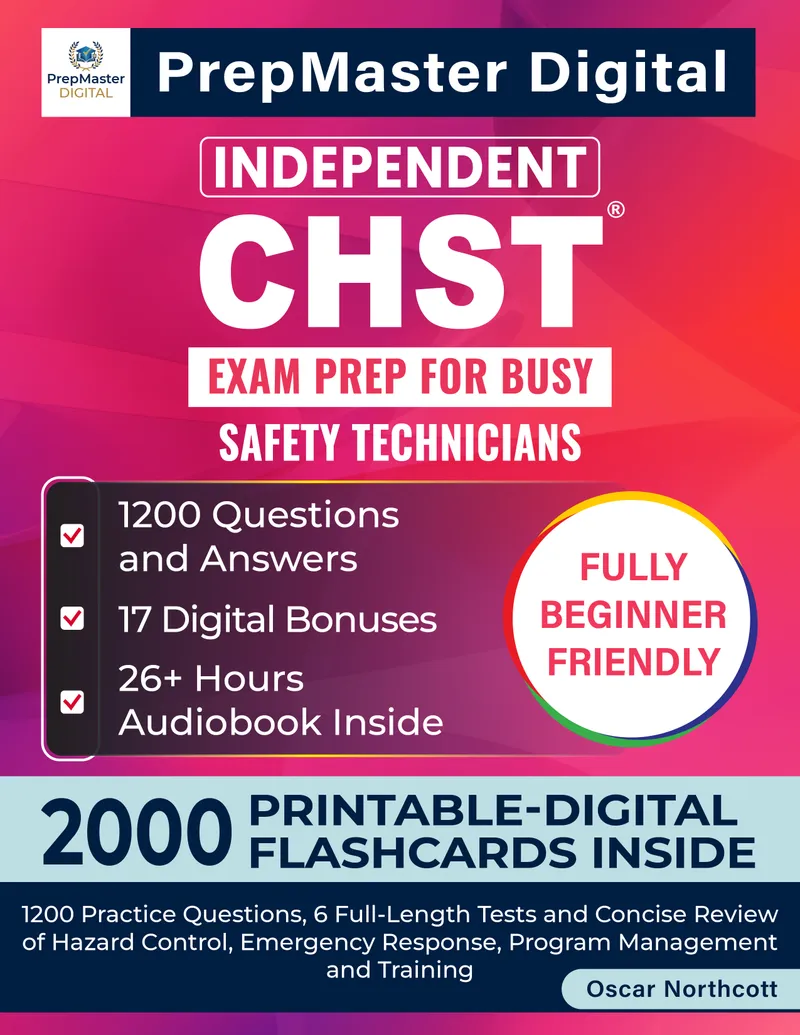
CHST Study Guide 2027-20281,200 practice questions with explained answers · 2,000 flashcards · 26.1-hour audiobook · AI tutor
Complete digital study edition
1200 Practice Questions, 6 Full-Length Tests and Concise Review of Hazard Control, Emergency Response, Program Management and Training
Pass with the PrepMaster Method. Every attempt covered.
Study guide, practice questions with explained answers, flashcards, audiobook, bonuses and an AI tutor. If you don't pass, our Retake Promise gives you the latest edition of everything, free, until you pass.
1. Measure
Take the free readiness test and see where you stand before you study.
2. Study
Work through one complete kit built on your exam's official outline, with the audiobook for the commute.
3. Ask
Stuck on a topic? The AI tutor answers from the chapters of your guide (5 free questions included).
4. Retake Promise
Didn't pass? Send us your official result and we give you everything, updated, free, for your next attempt.
5 sample CHST questions from the guide
Taken from the practice tests in the book, with the answer and the explanation the guide gives.
1. A concrete deck crew is pouring a roof in sections. The finished edge advances with each pour, and workers stand near the open perimeter. What does this condition represent, and what is an appropriate way to protect the workers?
- A. It is a fixed edge; a warning line alone is adequate for workers.
- B. It is a leading edge; workers should be protected by a personal fall arrest system anchored independently of the work surface.
- C. It is a low-slope roof; a safety monitor may be used for all employees.
- D. It is a hole protection situation; a strengthened cover is required for the open area.
Show the answer
Correct answer: B. A leading edge is an unprotected edge that changes location as the work progresses. A personal fall arrest system anchored to an independent support is a standard method of fall protection for leading-edge work.
2. During a weekly planning meeting, a team assigns probability and severity ratings to four hazards and calculates scores of 4, 6, 9, and 12. The supervisor then declares that only the score of 12 requires action. Which step is missing from the team's use of the risk matrix?
- A. Treating the calculated scores as a conversation starter to discuss why each rating was chosen and what controls are already in place.
- B. Having each worker sign the score sheet before any hazard is accepted.
- C. Averaging the four scores to determine a single site risk priority.
- D. Expanding the matrix to allow scores above 25.
Show the answer
Correct answer: A. The matrix ranks competing risks so the team can make a defensible decision; it does not automatically decide which hazards need action. The missing step is the conversation that examines the ratings and controls behind the numbers.
3. A crew is removing old epoxy coating from a concrete floor in a poorly ventilated pump room. Which control is an example of substitution?
- A. Providing chemical-resistant coveralls, gloves, and a full-face respirator
- B. Limiting each worker to two 30-minute periods of stripping per shift
- C. Switching from a methylene chloride based paint stripper to a water-based, low-volatility stripper that meets the project specification
- D. Connecting a high-volume exhaust fan to a window and ventilating the room before entry
Show the answer
Correct answer: C. Substitution replaces the hazardous material or process with a less hazardous one, so switching strippers is the correct response. Ventilation is an engineering control, the time limit is administrative, and protective clothing is PPE.
4. A construction site's emergency action plan includes a simple map of current exits, extinguishers, shutoffs, and the assembly area. How often should this site map be updated?
- A. Once when the emergency action plan is first written
- B. When the fire department schedules its annual visit
- C. Only after an evacuation drill reveals a problem
- D. At least once per week and whenever the physical site layout changes
Show the answer
Correct answer: D. The map is a living control that must be rechecked weekly and after any change such as a closed road, new crane, trench, or relocated trailer. A map written once cannot reflect changing site conditions.
5. Several trade employees need to pass near a controlled incident scene to reach an unaffected work area. How should the investigator manage access to the scene itself?
- A. Establish one entry point and have one designated person log every individual who enters or exits
- B. Permit only the project manager and safety manager to enter the scene
- C. Let the responding law enforcement officer admit personnel without logging, because the officer is trained to preserve evidence
- D. Allow each trade foreman to enter and retrieve tools as needed because they are familiar with the site
Show the answer
Correct answer: A. A single, logged entry point controls who is in the scene and creates a record of possible contamination. Unlogged or multiple entries make the evidence chain unreliable.
Some candidates cram. Smart ones prepare.
You have the field experience. Now you need a study resource that respects your time and targets the CHST blueprint. This guide delivers focused review and realistic practice, built for working safety technicians.
Everything you get
One purchase unlocks everything below, with no subscription. The only optional extra is the unlimited AI tutor upgrade. Here is exactly what unlocks the moment you buy, and how each part helps you.
1,200
practice questions — every answer explained
2,000
digital flashcards, ready to drill
~26.1h
of professional audio narration
14
downloadable study tools
Complete audiobook — about 26.1 hours
The entire book, professionally narrated. Stream it in your browser or download the MP3s and study on the commute, at the gym, or on a break — so the material sinks in even when you can't sit down to read.
AI Study Tutor — ask this book anything
A tutor that has read this exact book: ask about any topic, get an answer grounded in its own chapters, right on your access page. 5 questions are included free with your purchase, and the tutor upgrade gives you unlimited questions (fair use: 100 a day — write to us and we lift it).
- “Explain this topic in simple words, with an example.”
- “I got this question wrong: why is the right answer correct?” (paste the question)
- “Which chapter should I review for my weakest topic?”
90-Day CHST Study Planner (Fill-in Calendar)
A day-by-day schedule that carves your study blocks around a full-time safety job.
Hazard Control Field Checklist (Jobsite Review)
A printable walkthrough list to spot hazards the way the exam expects you to.
Emergency Response Decision Tree (Flowchart Script)
Step-by-step decision paths for incidents, from first call to final report.
CHST Formula and Calculation Sheet (Quick Reference)
Every formula and conversion you need for the math-heavy questions.
Program Management Terms Decoder (One-Page Glossary)
Plain-English definitions of 100+ CHST terms you must know cold.
Training Delivery Scriptbook (How to Teach Safety)
Ready-to-use talking points for effective worker training sessions.
Incident Investigation Interview Guide (Question Bank)
Key questions to ask witnesses and workers after an incident.
Worksite Audit Log (Fill-in Template)
A structured log to document inspections and findings.
Regulatory Reference Card (OSHA and More)
A quick list of the most-tested regulations, standards, and codes.
Time Management Strategy Sheet (During the Exam)
A minute-by-minute pacing plan for each full-length practice test.
Root Cause Analysis Worksheet (5 Whys and Fishbone)
A structured template to dig into the why behind any incident.
Safety Program Audit Checklist (Administrative Review)
A step-by-step list to evaluate a company's written safety program.
Exam Day Essentials Pack (Checklist and Reminders)
What to bring, what to expect, and how to stay sharp during the test.
CHST Domain-by-Domain Self-Assessment (Personalized Gap Finder)
Rate your readiness in each exam domain and target your weak spots.
Delivered as a PDF and EPUB you can read on any device, plus downloadable audio and toolkit files. Nothing to install, and your access never expires.
Everything you'll master, chapter by chapter
The complete syllabus of this guide — built on the official exam outline.
Chapter 1: Orientation and Study Strategy for the CHST
- ▸ Preparing for the CHST with a Full-Time Safety Job
- ▸ How the Book Organizes the Content Domains
- ▸ Building a Weekly Study Schedule That Fits Fieldwork
- ▸ Using Multiple-Choice Techniques and Answer Explanations Wisely
Chapter 2: Recognizing Construction Hazards Across Work Activities
- ▸ The Leading Injury Mechanisms and Their Site Sources
- ▸ Fall Hazards on Ladders, Scaffolds, Platforms, and Leading Edges
- ▸ Struck-By and Caught-Between Risks from Equipment, Loads, and Materials
- ▸ Electrical Hazards in Permanent and Temporary Power Situations
- ▸ Excavation, Trench, and Confined Space Hazard Recognition
- ▸ Fire and Explosion Hazards from Hot Work and Flammable Storage
- ▸ Recognizing Dust, Chemical, Noise, and Heat Health Hazards
Chapter 3: Risk Assessment, Prioritization, and Job Hazard Analysis
- ▸ Pairing Probability and Severity to Set Risk Priorities
- ▸ Writing Job Hazard Analyses That Support Task Decisions
- ▸ Using Pre-Task Planning to Put Risk Assessment on the Jobsite
- ▸ Prioritizing Many Hazards with Limited Time and Resources
- ▸ Updating Risk Assessments as Crews, Weather, and Phases Change
Chapter 4: Applying the Hierarchy of Controls and Personal Protective Equipment
- ▸ Choosing the Right Rung on the Hierarchy of Controls
- ▸ Engineering Controls for Isolation, Ventilation, Guarding, and Substitution
- ▸ Administrative Controls, Procedures, and Warning Systems
- ▸ Selecting, Fitting, and Maintaining Personal Protective Equipment
- ▸ Combining Controls for Electrocution, Falls, Struck-By, and Caught-Between Events
Chapter 5: Emergency Preparedness and Response on a Changing Construction Site
- ▸ Building an Emergency Action Plan for a Moving Work Site
- ▸ Assigning Roles, Assembly Points, and Headcount Procedures
- ▸ Responding to Medical Emergencies and Coordinating On-Site Rescue
- ▸ Managing Site-Specific Emergencies from Utility Strikes to Severe Weather
- ▸ Running Drills and Turning After-Action Reviews into Better Plans
Chapter 6: Incident Investigation, Root Cause Analysis, and Corrective Actions
- ▸ Securing the Scene and Controlling Secondary Risks
- ▸ Collecting Evidence, Records, and Witness Accounts
- ▸ Analyzing the Sequence from Immediate Causes to Root Causes
- ▸ Writing Recommendations That Target Root Causes and Prevent Recurrence
Chapter 7: Developing and Coordinating the Construction Safety Program
- ▸ Structuring the Written Program around Project Risks and Work Phases
- ▸ Establishing Clear Safety Roles for Owners, Contractors, Supervisors, and Workers
- ▸ Building Effective Hazard Reporting, Near-Miss, and Stop-Work Systems
- ▸ Coordinating Safety Requirements across Subcontractors and Multiple Employers
Chapter 8: Auditing, Measuring, and Sustaining the Safety Program
- ▸ Building an Inspection and Audit Cadence That Matches the Work
- ▸ Selecting and Interpreting Leading and Lagging Safety Indicators
- ▸ Improving the Program with Continuous Improvement Cycles
- ▸ Sustaining Safety during Turnover, Peaks, and Project Closeout
Chapter 9: Safety Leadership, Culture, and Jobsite Communication
- ▸ Demonstrating Visible Leadership and Management Commitment
- ▸ Coaching Supervisors in Safety Conversations and Corrective Feedback
- ▸ Communicating with a Multilingual Workforce at Every Literacy Level
- ▸ Managing Resistance and Building Participation in Safety Decisions
Chapter 10: Training Design, Delivery, and Evaluation for Construction Workers
- ▸ Setting Training Objectives and Linking Them to Job Tasks
- ▸ Choosing Delivery Methods from Toolbox Talks to Hands-On Practice
- ▸ Verifying Comprehension and Skill through Checks and Demonstrations
- ▸ Documenting Training, Retraining Triggers, and Competency Records
…plus the full-length practice exams with every answer explained.
How you get everything
No accounts to create, no waiting. Here is exactly what happens after you buy.
Buy securely
Checkout is handled by our payment provider over an encrypted connection. Pay by card in about a minute.
Get an instant email
Seconds after payment, we email you a private access link — no app to download, no signup to complete.
Open everything
Your access page unlocks the full digital edition, audiobook and toolkit. It is yours to keep, with lifetime access.
Retake Promise: you never pay twice
If you don't pass, tell us: we give you the newest edition of everything (the guide, practice questions, flashcards, audiobook, bonuses and the AI tutor), free, for every new attempt until you pass. We also let you know when new editions and new exam guides come out, and you get a personal 50% code on all our other guides to prepare for your next exam. Full terms.
Common questions
Is this an official exam product?
No — this is an independent study guide created to help you prepare. It isn't affiliated with or endorsed by the organization that administers the exam. All names and trademarks belong to their respective owners.
How do I get access after buying?
Immediately. Your private access link arrives by email within seconds of checkout, and it never expires.
What format is everything in?
You get the full guide as a PDF and EPUB, the audiobook as downloadable MP3s, and every study tool as a ready-to-use file. Nothing to install.
What's the difference between the digital and paperback edition?
Same complete guide. The digital edition gives you instant access right here plus the full toolkit. The Amazon paperback ships to you and unlocks the same toolkit with the code printed inside.
Can I get a refund?
Digital guides are delivered instantly, so we don't offer refunds. Instead there is the Retake Promise: if you don't pass, you get everything, updated, free, until you pass, and a personal 50% code on our other guides. Before you buy, try the free readiness test. Full terms of the Retake Promise. Your legal rights are not affected (refund policy).
Walk in prepared. Start today.
The complete guide, the practice questions, the audiobook and the full toolkit — unlocked the moment you buy, and yours to keep.
Already own the book? Redeem your code →
PrepMaster Digital is an independent publisher. This guide is not affiliated with or endorsed by the organization that administers the exam. All exam names and trademarks belong to their owners.
$66.99$19.99instant access