
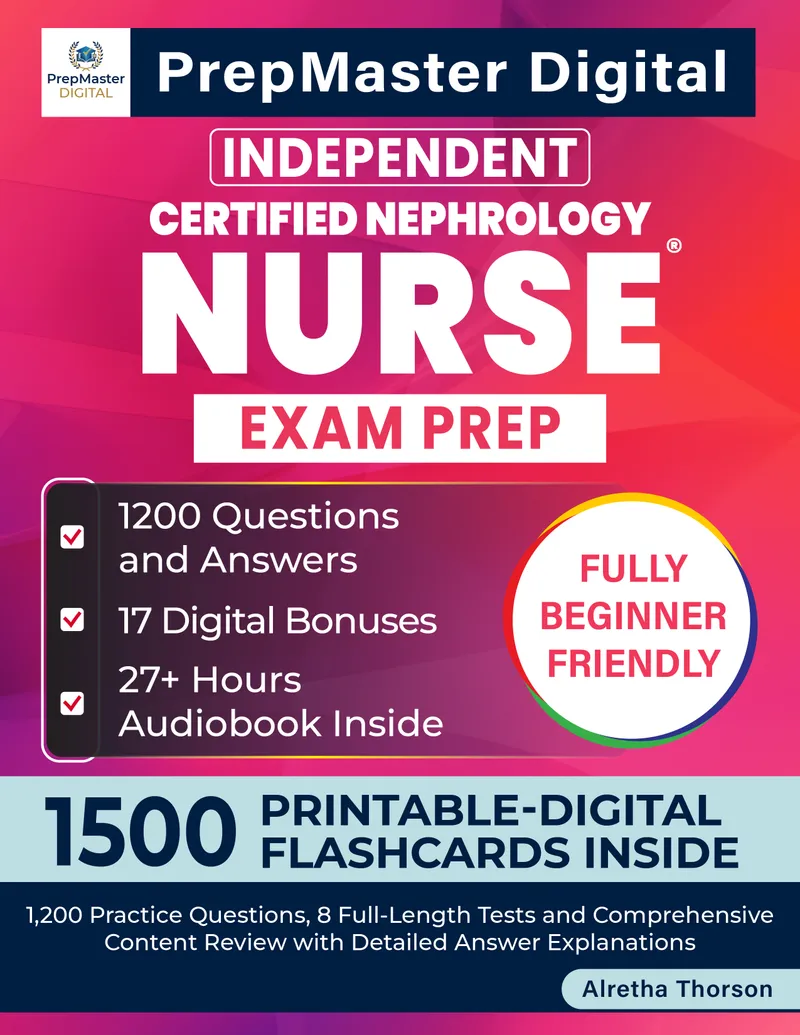
Certified Nephrology Nurse Study Guide 2027-20281,200 practice questions with explained answers · 1,500 flashcards · 27.9-hour audiobook · AI tutor
Complete digital study edition
1,200 Practice Questions, 8 Full-Length Tests and Comprehensive Content Review with Detailed Answer Explanations
Pass with the PrepMaster Method. Every attempt covered.
Study guide, practice questions with explained answers, flashcards, audiobook, bonuses and an AI tutor. If you don't pass, our Retake Promise gives you the latest edition of everything, free, until you pass.
1. Measure
Take the free readiness test and see where you stand before you study.
2. Study
Work through one complete kit built on your exam's official outline, with the audiobook for the commute.
3. Ask
Stuck on a topic? The AI tutor answers from the chapters of your guide (5 free questions included).
4. Retake Promise
Didn't pass? Send us your official result and we give you everything, updated, free, for your next attempt.
5 sample Certified Nephrology Nurse questions from the guide
Taken from the practice tests in the book, with the answer and the explanation the guide gives.
1. An investigational drug selectively blocks the high-affinity, low-capacity glucose transporter found in the straight segment of the proximal tubule. Which statement is accurate?
- A. It inhibits the Na/K-ATPase and collapses the sodium gradient throughout the nephron.
- B. It inhibits SGLT1 and reduces reabsorption of the remaining approximately 10% of filtered glucose.
- C. It inhibits SGLT2 and reduces reabsorption of about 90% of filtered glucose.
- D. It inhibits GLUT2 and impairs glucose exit across the basolateral membrane.
Show the answer
Correct answer: B. SGLT1 is located in the straight segment of the proximal tubule and is a high-affinity, lower-capacity transporter that reabsorbs the remaining about 10% of filtered glucose.
2. A 57-year-old with type 2 diabetes has A1c 6.8 percent on metformin, eGFR 82 mL/min per 1.73 m², urine albumin-to-creatinine ratio 210 mg/g, and blood pressure 126/78 mm Hg. Which finding is the strongest indication for adding an SGLT2 inhibitor?
- A. eGFR of 82 mL/min per 1.73 m², which confirms preserved filtration
- B. urine albumin-to-creatinine ratio of 210 mg/g despite A1c 6.8 percent
- C. need to replace metformin before eGFR falls below 30 mL/min per 1.73 m²
- D. systolic blood pressure of 126 mm Hg, which is at the treatment boundary
Show the answer
Correct answer: B. Persistent albuminuria is the indication for an SGLT2 inhibitor in diabetic kidney disease, and the benefit occurs independently of glycemic control. At an A1c of 6.8 percent, glucose lowering is not the reason to add the drug, and preserved eGFR alone also does not justify it.
3. An otherwise healthy 8-month-old is diagnosed with a first febrile urinary tract infection. Renal and bladder ultrasound shows no hydronephrosis, scarring, or other abnormality. Which approach to voiding cystourethrogram (VCUG) is most consistent with current AAP guidance?
- A. Do not perform VCUG now because the ultrasound is normal; obtain VCUG only if ultrasound shows hydronephrosis, scarring, or other findings suggesting high-grade reflux or obstruction
- B. Perform VCUG only after a follow-up urine culture is sterile
- C. Perform VCUG now because any febrile UTI in an infant warrants an immediate study
- D. Obtain VCUG regardless of ultrasound findings because reflux can be present even with a normal ultrasound
Show the answer
Correct answer: A. After a first febrile UTI in an infant, the AAP recommends VCUG only when the renal and bladder ultrasound shows hydronephrosis, scarring, or another finding suggestive of high-grade reflux or obstruction. A normal ultrasound does not exclude reflux, but it eliminates the need for immediate VCUG in this setting.
4. A patient develops AKI while receiving vancomycin and piperacillin-tazobactam. Which fractional excretion of sodium value is most consistent with nephrotoxic ATN?
- A. 3.2 percent
- B. 0.4 percent
- C. 0.8 percent
- D. 1.5 percent
Show the answer
Correct answer: A. FENa above 2 percent is characteristic of ATN because the injured tubule fails to reabsorb sodium. Values below 1 percent suggest prerenal physiology, while the 1 to 2 percent range is indeterminate.
5. A CRRT circuit is changed to use pre-filter replacement fluid. Which expected effect on filtration fraction is accurate?
- A. It increases filtration fraction by adding fluid to the ultrafiltrate.
- B. It has no effect because dialysate flow is unchanged.
- C. It decreases filtration fraction by diluting the blood entering the filter.
- D. It decreases the ultrafiltration rate by lowering blood viscosity.
Show the answer
Correct answer: C. Pre-filter replacement fluid dilutes the blood before it reaches the hemofilter, increasing the plasma flow presented to the membrane and lowering the filtration fraction. Solutions given after the filter do not have this protective effect.
Your CNN certification is within reach with this focused, high-yield prep.
You have the clinical experience and the drive. What you need is a study resource that zeroes in on what matters, without the fluff. This guide distills the full spectrum of nephrology nursing into a clear, structured path that respects your time and your intelligence.
Everything you get
One purchase unlocks everything below, with no subscription. The only optional extra is the unlimited AI tutor upgrade. Here is exactly what unlocks the moment you buy, and how each part helps you.
1,200
practice questions — every answer explained
1,500
digital flashcards, ready to drill
~27.9h
of professional audio narration
14
downloadable study tools
Complete audiobook — about 27.9 hours
The entire book, professionally narrated. Stream it in your browser or download the MP3s and study on the commute, at the gym, or on a break — so the material sinks in even when you can't sit down to read.
AI Study Tutor — ask this book anything
A tutor that has read this exact book: ask about any topic, get an answer grounded in its own chapters, right on your access page. 5 questions are included free with your purchase, and the tutor upgrade gives you unlimited questions (fair use: 100 a day — write to us and we lift it).
- “Explain this topic in simple words, with an example.”
- “I got this question wrong: why is the right answer correct?” (paste the question)
- “Which chapter should I review for my weakest topic?”
CNN Exam Blueprint-to-Study Plan Checklist
Aligns your study schedule with the official content domains so you cover every area systematically.
Nephrology Medications Master Decoder
Quick-reference for drug classes, dosing considerations, and nursing implications.
Acute Kidney Injury Rapid Review Protocol Cards
At-a-glance cards for causes, staging, and management of AKI.
Hemodialysis Complications Tracker
Log intradialytic events and your response plan for each complication.
Peritoneal Dialysis Troubleshooting Field Guide
Step-by-step guidance for common PD issues, from catheter problems to infection signs.
Home Hemodialysis Patient Education Toolkit
Templates and talking points to teach patients self-care and safety.
Transplant Immunosuppression Comparison Chart
Side-by-side of common immunosuppressants, including monitoring and side effects.
Fluid and Electrolyte Balance Worksheet
Fill-in exercises to master labs, imbalances, and replacement strategies.
Renal Replacement Therapy Modality Selector
Decision tree to match patient needs with the appropriate dialysis modality.
Lab Values Quick Reference Card
Essential nephrology labs with normal ranges and critical thinking prompts.
Nutrition in Kidney Disease Pocket Guide
Dietary considerations for CKD, dialysis, and transplant patients.
Vascular Access Assessment Checklist
Systematic evaluation of AV fistulas, grafts, and catheters.
Exam Day Strategy and Time Management Scriptbook
Pre-planned approaches to pacing, question analysis, and handling difficult items.
90-Day Personalized Study Calendar
Editable daily schedule to structure your review and practice test sessions.
Delivered as a PDF and EPUB you can read on any device, plus downloadable audio and toolkit files. Nothing to install, and your access never expires.
Everything you'll master, chapter by chapter
The complete syllabus of this guide — built on the official exam outline.
Chapter 1: How to Use This Guide, Blueprint-Based Study Planning and Test-Day Strategy
- ▸ Mapping the CNN Exam Blueprint to Your Personal Study Priorities
- ▸ Building a Flexible Study Rotation Around Shift Work
- ▸ Using an Error Log to Get the Most From Every Rationale
- ▸ Timing the 150-Question, Three-Hour Exam, Checkpoints and Pacing Rules
Chapter 2: Renal Anatomy and Diagnostic Evaluation, Nephron Function, Clearance, and Test Interpretation
- ▸ Moving Through the Nephron, Filtration, Reabsorption, Secretion, and Hormonal Action
- ▸ Interpreting GFR, Serum Creatinine, BUN, and Cystatin C
- ▸ Reading the Urine, Protein, Blood, Sediment, and Microscopic Clues
- ▸ Renal Imaging, Biopsy, and Genetic Tests, When and What to Use
Chapter 3: Chronic Kidney Disease Mechanisms and Complications, From Primary Causes to Staging
- ▸ Diabetic and Hypertensive Nephropathy, Mechanisms, Surveillance, and Therapy Outlook
- ▸ Nephritic versus Nephrotic Injury, Pattern Recognition and Treatment Direction
- ▸ CKD Staging and Risk Trajectory, Translating eGFR and Albuminuria Into Decisions
- ▸ Anemia, Metabolic Bone Disease, and Cardiovascular Complications in CKD
- ▸ Chronic Kidney Disease Medications and Nutrition, Safe Prescribing and Everyday Guidance
Chapter 4: Kidney Disease Across the Life Span, Pediatric, Pregnancy, Geriatric, and Conservative Care
- ▸ Congenital and Inherited Kidney Diseases, From Vesicoureteral Reflux to Polycystic Kidney Disease
- ▸ Kidney Disease in Children, Growth, Nutrition, and Developmentally Appropriate Care
- ▸ Pregnancy and Kidney Disease, Managing Preeclampsia Risk and Drug Contraindications
- ▸ Aging, Frailty, and the Older Adult Kidney, Adjusting Care and Goals
- ▸ Conservative Kidney Management and Advance Care Planning Across the Life Span
Chapter 5: Acute Kidney Injury and Inpatient Care, Detection, Prevention, and Non-Dialysis Management
- ▸ Prerenal, Intrinsic, and Postrenal AKI, Pattern Recognition at the Bedside
- ▸ Sepsis, Contrast Exposure, and Nephrotoxic Medications, Prevention Bundles That Preserve Kidneys
- ▸ Fluid, Electrolyte, and Acid-Base Management in the Patient With AKI
- ▸ Daily Inpatient Monitoring, Volume Status, Renal Recovery, and Nutrition
Chapter 6: Acute Renal Replacement Therapy, Intermittent Hemodialysis, CRRT, and Inpatient Vascular Access
- ▸ Selecting an Inpatient Extracorporeal Therapy, Intermittent Hemodialysis, CRRT, and SLED
- ▸ CRRT Prescription and Anticoagulation, Membrane, Flow, and Filter Troubleshooting
- ▸ Inpatient Dialysis Access, Temporary Catheters, Site Selection, and Access Preservation
- ▸ Recognizing and Managing Acute Dialysis Complications, Hypotension, Air Embolism, and Disequilibrium
Chapter 7: Peritoneal Dialysis Essentials, Membrane Physiology, Catheters, Fluids, and Prescriptions
- ▸ Peritoneal Membrane Transport Physiology, Solute Movement, Ultrafiltration, and Dwell Dynamics
- ▸ Catheter Selection, Implantation, and Break-In Care, Preventing Early Flow Problems
- ▸ Peritoneal Dialysis Solutions, Glucose, Icodextrin, Amino Acid, and Low-GDP Formulations
- ▸ Crafting the Initial PD Prescription, Volume, Dwell, Cycles, and Modality Choice
Chapter 8: Peritoneal Dialysis in Practice, Adequacy, Complications, and Patient Education
- ▸ Measuring and Interpreting Transport, The PET, Kt/V, and Weekly Creatinine Clearance
- ▸ Peritonitis Prevention and Management, Contamination Protocols and Timely Antibiotic Therapy
- ▸ Catheter Survival and Mechanical Problems, Leaks, Obstruction, Migration, and Hernias
- ▸ Long-Term Metabolic Consequences, Ultrafiltration Failure and Encapsulating Peritoneal Sclerosis
- ▸ Structured Patient and Care Partner Training, Return Demonstrations and Routine Refreshers
Chapter 9: Home Hemodialysis, Treatment Regimens, Access, Training, and Safety
- ▸ Putting Home Hemodialysis Together, Short Daily, Conventional, and Nocturnal Regimens
- ▸ Vascular Access for Home, Fistula and Graft Cannulation, Buttonhole Method, and Surveillance
- ▸ Training Patients and Care Partners, Core Competencies, Home Setup, and Emergency Procedures
- ▸ Home Machine and Water Safety, Alarm Response, Water Quality, and Preventive Maintenance
- ▸ Coordinating the Home Dialysis Care Plan, Medications, Volume Control, and Outcome Monitoring
Chapter 10: Kidney Transplantation, Candidate Evaluation, Immunosuppression, and Long-Term Graft Surveillance
- ▸ Transplant Candidate Evaluation, Cardiac, Infectious, Malignancy, and Psychosocial Screening
- ▸ Kidney Matching and Donor Processes, Blood Type, HLA, Crossmatch, and Donor Consent
- ▸ Immunosuppression Essentials, Induction Agents, Maintenance Drugs, and Adherence
- ▸ Post-Transplant Complications and Long-Term Follow-Up, Rejection, Infection, and Comorbidity Control
…plus the full-length practice exams with every answer explained.
How you get everything
No accounts to create, no waiting. Here is exactly what happens after you buy.
Buy securely
Checkout is handled by our payment provider over an encrypted connection. Pay by card in about a minute.
Get an instant email
Seconds after payment, we email you a private access link — no app to download, no signup to complete.
Open everything
Your access page unlocks the full digital edition, audiobook and toolkit. It is yours to keep, with lifetime access.
Retake Promise: you never pay twice
If you don't pass, tell us: we give you the newest edition of everything (the guide, practice questions, flashcards, audiobook, bonuses and the AI tutor), free, for every new attempt until you pass. We also let you know when new editions and new exam guides come out, and you get a personal 50% code on all our other guides to prepare for your next exam. Full terms.
Common questions
Is this an official exam product?
No — this is an independent study guide created to help you prepare. It isn't affiliated with or endorsed by the organization that administers the exam. All names and trademarks belong to their respective owners.
How do I get access after buying?
Immediately. Your private access link arrives by email within seconds of checkout, and it never expires.
What format is everything in?
You get the full guide as a PDF and EPUB, the audiobook as downloadable MP3s, and every study tool as a ready-to-use file. Nothing to install.
What's the difference between the digital and paperback edition?
Same complete guide. The digital edition gives you instant access right here plus the full toolkit. The Amazon paperback ships to you and unlocks the same toolkit with the code printed inside.
Can I get a refund?
Digital guides are delivered instantly, so we don't offer refunds. Instead there is the Retake Promise: if you don't pass, you get everything, updated, free, until you pass, and a personal 50% code on our other guides. Before you buy, try the free readiness test. Full terms of the Retake Promise. Your legal rights are not affected (refund policy).
Walk in prepared. Start today.
The complete guide, the practice questions, the audiobook and the full toolkit — unlocked the moment you buy, and yours to keep.
Already own the book? Redeem your code →
PrepMaster Digital is an independent publisher. This guide is not affiliated with or endorsed by the organization that administers the exam. All exam names and trademarks belong to their owners.
$66.99$19.99instant access