
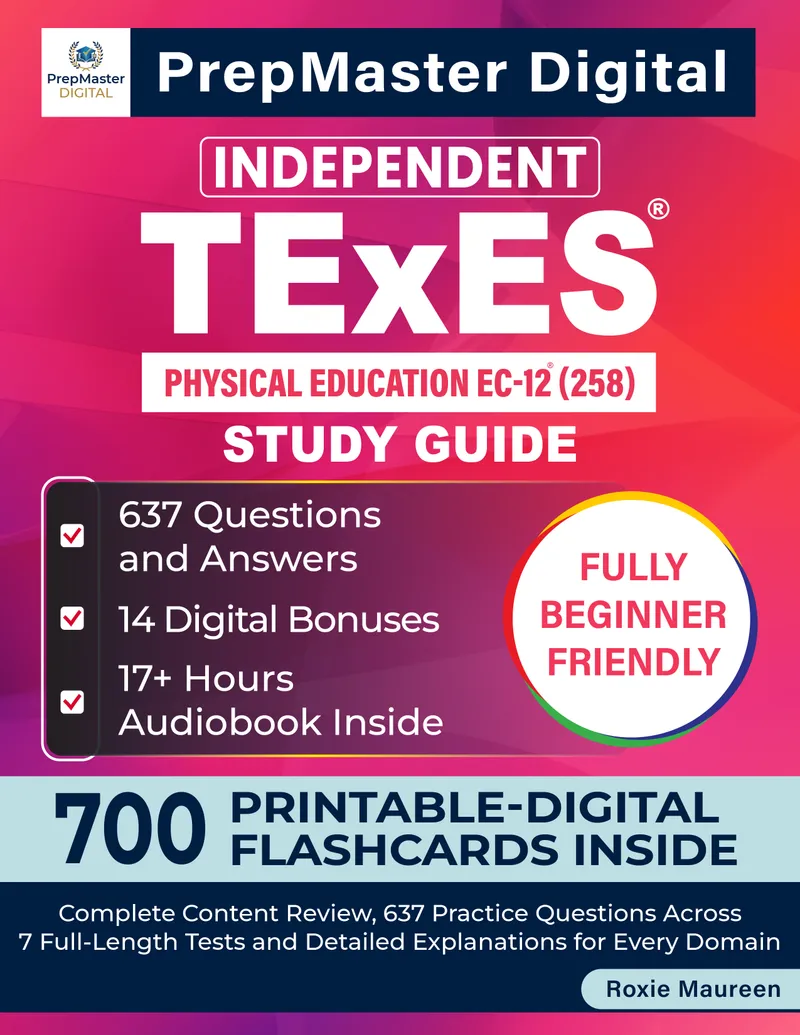
TExES Physical Education EC-12 (258) Study Guide 2027-2028637 practice questions with explained answers · 700 flashcards · 17.9-hour audiobook · AI tutor
Complete digital study edition
Complete Content Review, 637 Practice Questions Across 7 Full-Length Tests and Detailed Explanations for Every Domain
Pass with the PrepMaster Method. Every attempt covered.
Study guide, practice questions with explained answers, flashcards, audiobook, bonuses and an AI tutor. If you don't pass, our Retake Promise gives you the latest edition of everything, free, until you pass.
1. Measure
Take the free readiness test and see where you stand before you study.
2. Study
Work through one complete kit built on your exam's official outline, with the audiobook for the commute.
3. Ask
Stuck on a topic? The AI tutor answers from the chapters of your guide (5 free questions included).
4. Retake Promise
Didn't pass? Send us your official result and we give you everything, updated, free, for your next attempt.
5 sample TExES Physical Education EC-12 (258) questions from the guide
Taken from the practice tests in the book, with the answer and the explanation the guide gives.
1. During a newborn screening, a nurse gently strokes the infant's right cheek, and the infant turns his head toward the touch and opens his mouth. Which reflex is the nurse assessing?
- A. Grasping reflex
- B. Moro reflex
- C. Rooting reflex
- D. Babinski reflex
Show the answer
Correct answer: C. The rooting reflex is triggered by stroking the cheek, causing the head to turn toward the touch. The Moro reflex is a startle response, the grasping reflex involves finger closure around an object in the palm, and the Babinski reflex is elicited by stroking the sole.
2. A student takes a single free throw shot during a basketball game. Which characteristic makes this a discrete motor skill?
- A. The movement repeats continuously until the buzzer sounds
- B. The skill has no clear starting or ending point
- C. The skill combines several separate skills in a fixed sequence
- D. The action has a clear beginning and end and lasts only moments
Show the answer
Correct answer: D. A discrete skill is a single, identifiable action with a definite start and finish. The free throw fits this definition, unlike continuous movements or serial sequences that link multiple components.
3. A teacher asks students to show all three movement levels. Which movement best demonstrates the high level?
- A. Kneeling with hands on the floor
- B. Crouching with hands on knees
- C. Standing with arms stretched overhead
- D. Rolling on the floor
Show the answer
Correct answer: C. The high level is movement above the shoulders, and standing with arms stretched overhead best matches it. Rolling, crouching, and kneeling all occur at low or medium levels.
4. Muscular strength is BEST defined as which of the following?
- A. The ability to perform many repetitions of an exercise before fatigue
- B. The range of motion available at a joint
- C. The maximum force a muscle or muscle group can produce in a single effort
- D. The percentage of body weight that is fat tissue
Show the answer
Correct answer: C. Muscular strength is the highest amount of force a muscle or muscle group can generate in one maximal effort. Many repetitions before fatigue describes muscular endurance, and the other options describe flexibility and body composition.
5. According to standard health-related fitness recommendations, how many days per week should a student perform cardiorespiratory endurance training to improve aerobic fitness?
- A. 1 to 2 days per week
- B. 3 to 5 days per week
- C. 5 to 7 days per week
- D. Every day of the week
Show the answer
Correct answer: B. The standard frequency for cardiorespiratory endurance is 3 to 5 days per week. Fewer than 3 days supplies less than the minimum stimulus, and daily training without planned recovery increases injury risk.
What top scorers know: breadth beats cramming.
The TExES Physical Education EC-12 exam spans five distinct domains, from motor development to professional practice. This book was engineered to close that gap with deep, structured review and relentless practice.
Everything you get
One purchase unlocks everything below, with no subscription. The only optional extra is the unlimited AI tutor upgrade. Here is exactly what unlocks the moment you buy, and how each part helps you.
637
practice questions — every answer explained
700
digital flashcards, ready to drill
~17.9h
of professional audio narration
11
downloadable study tools
Complete audiobook — about 17.9 hours
The entire book, professionally narrated. Stream it in your browser or download the MP3s and study on the commute, at the gym, or on a break — so the material sinks in even when you can't sit down to read.
AI Study Tutor — ask this book anything
A tutor that has read this exact book: ask about any topic, get an answer grounded in its own chapters, right on your access page. 5 questions are included free with your purchase, and the tutor upgrade gives you unlimited questions (fair use: 100 a day — write to us and we lift it).
- “Explain this topic in simple words, with an example.”
- “I got this question wrong: why is the right answer correct?” (paste the question)
- “Which chapter should I review for my weakest topic?”
90-Day TExES PE EC-12 Study Calendar (Customizable Tracker)
A day-by-day plan that every domain and practice test to your exam date.
Motor Skills & Movement Concepts Quick-Review Cheat Sheet
Condensed key terms, stages, and cues for the Movement Knowledge domain.
Health-Related Fitness Formula & Protocol Decoder
Decode fitness assessments, FITT, and training principles in plain English.
Physical Education Program Planning Worksheet (Fill-in PDF)
Structure your PE program vision, goals, and safety plans step by step.
Inclusion Strategies Playbook for Diverse Learners
Practical adaptations for students with disabilities, ELLs, and varied skill levels.
Professional Practice Scenarios Scriptbook
Practice ethical and professional decision-making with real-world scenarios.
Constructed Response Essay Outline Builder
A fill-in-the-blank framework for the constructed response section.
Test-Day Logistics Checklist & Time-Budget Card
What to bring, what to expect, and how to pace your 5-hour exam.
Vocabulary Master List
The essential terminology across all five domains, alphabetized and printable.
Reflection Journal for Teaching Practice
Digest each practice test and sharpen your teaching philosophy.
Exam Readiness Self-Assessment Rubric
Rate your mastery of each domain and target your remaining study time.
Delivered as a PDF and EPUB you can read on any device, plus downloadable audio and toolkit files. Nothing to install, and your access never expires.
Everything you'll master, chapter by chapter
The complete syllabus of this guide — built on the official exam outline.
Chapter 1: Orientation and Study Blueprint, Inside the TExES Physical Education EC-12
- ▸ How the 91 Questions and Five-Hour Time Limit Shape Your Preparation
- ▸ Choosing What to Study First, A Priority Matrix Based on the Five Domains
- ▸ Building a Realistic Twelve-Week Study Calendar Around Work and Family
- ▸ How to Mine the Practice Questions in This Book for Maximum Learning
- ▸ Preparing Your Body and Mind for a Long Computer-Administered Session
Chapter 2: Human Growth and Motor Development From Early Childhood Through Adolescence
- ▸ The Stages of Motor Development, From Reflexes to Specialized Movement
- ▸ Physical Growth in Childhood and Adolescence, Height, Weight, and Body Systems
- ▸ Maturation Rate and Individual Differences in Motor Performance
- ▸ Classic Milestones in Locomotor, Stability, and Manipulative Skills
- ▸ Learner Characteristics Across Grade Bands and Their Implications
Chapter 3: Motor Learning and Biomechanical Principles for Skill Acquisition
- ▸ Classifying Motor Skills, Open, Closed, Discrete, Serial, and Continuous
- ▸ The Stages of Learning a Motor Skill, Cognitive, Associative, and Autonomous
- ▸ Practice Design, Blocked Versus Random, Massed Versus Distributed
- ▸ Feedback That Works, Intrinsic, Extrinsic, Results, and Performance
- ▸ Transfer of Learning and How to Set Up Positive Transfer
- ▸ Applying Biomechanical Principles, Force, Levers, Balance, and Projectiles
Chapter 4: Movement Forms, Games, Dance, Gymnastics, and Lifetime Activities
- ▸ Using the Movement Concepts Framework, Space, Effort, Relationships, and Body
- ▸ Critical Elements of Locomotor, Nonlocomotor, and Manipulative Skills
- ▸ Analyzing Games and Sport Skills, Invasion, Net, Target, and Striking
- ▸ Dance and Rhythmic Movement, Forms, Sequences, and Movement Quality
- ▸ Educational Gymnastics, Weight Transfer, Balances, and Flight
- ▸ Lifetime and Outdoor Activities That Support Active Living
Chapter 5: Health-Related Fitness, Components, Measurements, and Assessment
- ▸ The Five Components of Health-Related Fitness, Definitions and Relationships
- ▸ Assessing Cardiorespiratory Fitness, Tests, Protocols, and Pacing
- ▸ Assessing Muscular Strength and Endurance, Common Field Tests
- ▸ Assessing Flexibility and Body Composition, Tools, Protocols, and Error Sources
- ▸ Getting Valid Results, Standardization, Motivation, and Student Preparation
Chapter 6: Fitness Program Design and Physical Activity Promotion
- ▸ FITT Principle and How to Adjust Each Variable
- ▸ Monitoring Intensity, Heart Rate Zones, RPE, and the Talk Test
- ▸ Training Methods Compared, Continuous, Interval, Circuit, and Resistance
- ▸ Building Individualized Fitness Plans With Student Input
- ▸ Promoting Physical Activity Beyond Class Time
Chapter 7: Designing a Sequential Physical Education Curriculum
- ▸ Choosing a Curriculum Model, Fitness Education, Skill Themes, Sport Education, and Adventure
- ▸ Creating a Scope and Sequence Across Grade Levels
- ▸ Writing Measurable Learning Objectives for PE Units
- ▸ Aligning PE Outcomes With State Standards and School Priorities
- ▸ Integrating Physical Literacy, Social Growth, and Cognitive Learning
- ▸ Developing Unit Plans That Progress From Exploration to Performance
Chapter 8: Instructional Strategies and Class Management in Physical Education
- ▸ Anatomy of a PE Lesson, Start, Skill Work, Practice, and Closure
- ▸ Teaching Styles From Command to Guided Discovery and Their Tradeoffs
- ▸ The Eight-Step Skill Presentation, Demonstrating, Cueing, and Checking
- ▸ Grouping Strategies, Stations, Partners, Small Groups, and Whole-Class Formats
- ▸ Managing Space, Equipment, and Time to Keep Students Engaged
- ▸ Positive Behavior Management, Rules, Routines, Responses, and Restorative Practices
Chapter 9: Safety, Risk Management, and the Operation of a PE Program
- ▸ Risk Management and the Annual Safety Audit
- ▸ Emergency Action Plans, Common Injuries, and Return-to-Activity Decisions
- ▸ Supervision and Legal Liability, What a PE Teacher Must Do
- ▸ Choosing, Inspecting, and Maintaining Equipment
- ▸ Scheduling Spaces, Budgeting Resources, and Managing Facilities
Chapter 10: Educating All Learners, Differentiation and Inclusive Physical Education
- ▸ Inclusive PE, The Continuum From General to Specialized Support
- ▸ Using the STEP Framework, Space, Task, Equipment, and People
- ▸ Differentiating by Readiness, Interest, and Learning Profile
- ▸ Supporting Students With Chronic Health Conditions in Physical Activity
- ▸ Culturally Responsive Teaching and Supporting English Learners in PE
- ▸ Extending Challenge for Advanced, Skilled, and Gifted Learners
Chapter 11: Professional Practice, Communication, and Ethical Responsibilities
- ▸ Professional Ethics and the PE Teacher's Responsibilities
- ▸ Collaborating With Colleagues, Administrators, and Support Staff
- ▸ Clear Communication With Families and the Community
- ▸ Reflective Practice and Using Student Data to Improve Teaching
- ▸ Sustaining Professional Growth Through Learning Communities
Chapter 12: Constructed Response, Planning, Writing, and Reviewing Your Answer
- ▸ Decoding the Constructed Response Prompt, Task, Scenario, and Constraints
- ▸ A Five-Step Method for Analyzing the Scenario and Planning Your Response
- ▸ Choosing the Best Teaching Decision and Justifying It With Evidence
- ▸ Structuring Your Response, Introduction, Body, and Conclusion
- ▸ Writing Clearly Under Time Pressure, Vocabulary, Sentences, and Editing
- ▸ Common Traps, Vague Answers, Long Intros, and Unsupported Claims
…plus the full-length practice exams with every answer explained.
How you get everything
No accounts to create, no waiting. Here is exactly what happens after you buy.
Buy securely
Checkout is handled by our payment provider over an encrypted connection. Pay by card in about a minute.
Get an instant email
Seconds after payment, we email you a private access link — no app to download, no signup to complete.
Open everything
Your access page unlocks the full digital edition, audiobook and toolkit. It is yours to keep, with lifetime access.
Retake Promise: you never pay twice
If you don't pass, tell us: we give you the newest edition of everything (the guide, practice questions, flashcards, audiobook, bonuses and the AI tutor), free, for every new attempt until you pass. We also let you know when new editions and new exam guides come out, and you get a personal 50% code on all our other guides to prepare for your next exam. Full terms.
Common questions
Is this an official exam product?
No — this is an independent study guide created to help you prepare. It isn't affiliated with or endorsed by the organization that administers the exam. All names and trademarks belong to their respective owners.
How do I get access after buying?
Immediately. Your private access link arrives by email within seconds of checkout, and it never expires.
What format is everything in?
You get the full guide as a PDF and EPUB, the audiobook as downloadable MP3s, and every study tool as a ready-to-use file. Nothing to install.
What's the difference between the digital and paperback edition?
Same complete guide. The digital edition gives you instant access right here plus the full toolkit. The Amazon paperback ships to you and unlocks the same toolkit with the code printed inside.
Can I get a refund?
Digital guides are delivered instantly, so we don't offer refunds. Instead there is the Retake Promise: if you don't pass, you get everything, updated, free, until you pass, and a personal 50% code on our other guides. Before you buy, try the free readiness test. Full terms of the Retake Promise. Your legal rights are not affected (refund policy).
Walk in prepared. Start today.
The complete guide, the practice questions, the audiobook and the full toolkit — unlocked the moment you buy, and yours to keep.
Already own the book? Redeem your code →
PrepMaster Digital is an independent publisher. This guide is not affiliated with or endorsed by the organization that administers the exam. All exam names and trademarks belong to their owners.
$66.99$19.99instant access