
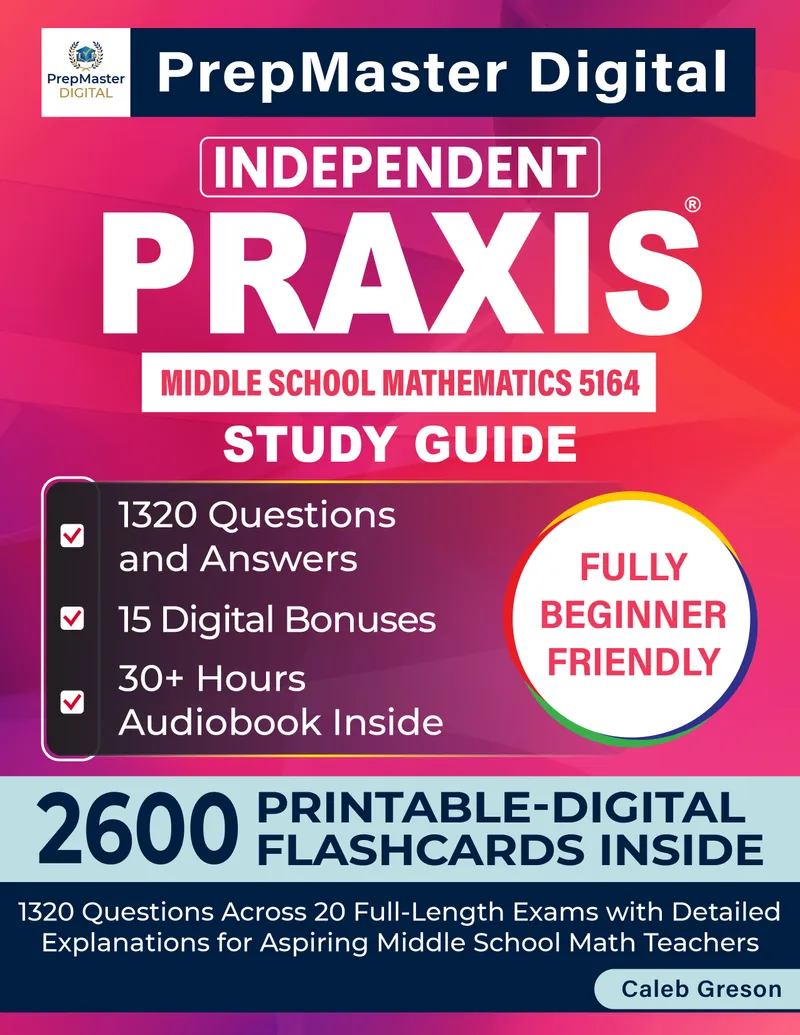
Praxis Middle School Mathematics 5164 Study Guide 2027-20281,320 practice questions with explained answers · 2,600 flashcards · 30.8-hour audiobook · AI tutor
Complete digital study edition
1320 Questions Across 20 Full-Length Exams with Detailed Explanations for Aspiring Middle School Math Teachers
Pass with the PrepMaster Method. Every attempt covered.
Study guide, practice questions with explained answers, flashcards, audiobook, bonuses and an AI tutor. If you don't pass, our Retake Promise gives you the latest edition of everything, free, until you pass.
1. Measure
Take the free readiness test and see where you stand before you study.
2. Study
Work through one complete kit built on your exam's official outline, with the audiobook for the commute.
3. Ask
Stuck on a topic? The AI tutor answers from the chapters of your guide (5 free questions included).
4. Retake Promise
Didn't pass? Send us your official result and we give you everything, updated, free, for your next attempt.
5 sample Praxis Middle School Mathematics 5164 questions from the guide
Taken from the practice tests in the book, with the answer and the explanation the guide gives.
1. Which classification is true for the square root of 9?
- A. It is a whole number and an integer, but it is not a natural number.
- B. It is rational but not an integer because it is between 2 and 3.
- C. It is a natural number, a whole number, an integer, and a rational number because it simplifies to 3.
- D. It is irrational because it is written with a radical symbol.
Show the answer
Correct answer: C. The square root of 9 is 3. Because 3 is a natural number, it is also a whole number, an integer, and a rational number. Simplifying before classifying prevents the error of treating the radical form as irrational.
2. A student rewrites 59/9 as a mixed number using division: 59 divided by 9 gives a quotient of 6 with a remainder of 5. Which part of this division becomes the whole-number part of the mixed number?
- A. The divisor, 9
- B. The remainder, 5
- C. The dividend, 59
- D. The quotient, 6
Show the answer
Correct answer: D. The quotient from the division tells how many complete wholes are represented, so it becomes the whole-number part.
3. At a bakery, a recipe uses 8 cups of flour for every 2 cups of sugar. Which expression correctly represents the ratio of flour to sugar as a division comparison?
- A. 2 / 8
- B. 8 + 2
- C. 8 x 2
- D. 8 / 2
Show the answer
Correct answer: D. A ratio is a comparison by division, so the first quantity named, flour, is divided by the second quantity, sugar. The expression 2 / 8 would compare sugar to flour, not flour to sugar.
4. A textbook order charges a $25 handling fee plus $4 per book. Which quantity should be represented by a variable in an expression for the total cost?
- A. The total cost
- B. The number of books ordered
- C. The $25 handling fee
- D. The $4 per-book charge
Show the answer
Correct answer: B. The number of books ordered is the input that changes, so it is the variable. The handling fee and the per-book charge are fixed values, and the total cost is the output that depends on the variable.
5. A system of two linear equations has exactly one solution. On the coordinate plane, which statement correctly describes that solution?
- A. As the x-intercept of either line
- B. As the point where the two lines intersect
- C. As the point where the two lines have equal slopes
- D. As the point where one line crosses the y-axis
Show the answer
Correct answer: B. A solution is an ordered pair that satisfies both equations, so its graph must lie on both lines; the only such point is the intersection of the two lines. An intercept belongs to only one line, and equal slopes do not locate a shared point.
Your future students are counting on you.
The Praxis 5164 is a rigorous test of math content and teaching skill. This guide is engineered to close the gap between where you are and where you need to be. Every domain is covered in depth and the practice is relentless.
Everything you get
One purchase unlocks everything below, with no subscription. The only optional extra is the unlimited AI tutor upgrade. Here is exactly what unlocks the moment you buy, and how each part helps you.
1,320
practice questions — every answer explained
2,600
digital flashcards, ready to drill
~30.8h
of professional audio narration
12
downloadable study tools
Complete audiobook — about 30.8 hours
The entire book, professionally narrated. Stream it in your browser or download the MP3s and study on the commute, at the gym, or on a break — so the material sinks in even when you can't sit down to read.
AI Study Tutor — ask this book anything
A tutor that has read this exact book: ask about any topic, get an answer grounded in its own chapters, right on your access page. 5 questions are included free with your purchase, and the tutor upgrade gives you unlimited questions (fair use: 100 a day — write to us and we lift it).
- “Explain this topic in simple words, with an example.”
- “I got this question wrong: why is the right answer correct?” (paste the question)
- “Which chapter should I review for my weakest topic?”
Diagnostic Math Readiness Assessment & Scoring Guide
Pinpoint your weak areas before you start with a self-scoring diagnostic aligned to the exam's domains.
60-Day Personalized Study Calendar & Tracker
A day-by-day plan that structures your review, practice tests, and review sessions around your schedule.
Formula & Theorem Quick-Reference Sheet
All the key formulas and theorems you need, condensed for quick review before test day.
Error Log & Mistake Tracker
Systematically record every missed question to identify patterns and eliminate repeated errors.
Math Terminology Glossary Decoder
Plain-English definitions of every math term and concept you'll encounter on the exam.
Practice Test Answer Sheet Templates
Printable answer sheets that simulate the real testing experience for each full-length exam.
Mental Math & Estimation Drill Pack
Quick-fire exercises to sharpen your arithmetic speed and number sense.
Word Problem Translation Toolkit
Step-by-step strategies for converting tricky word problems into solvable equations.
Graph Interpretation Field Guide
Learn to read and analyze graphs, charts, and data displays with confidence.
Geometry Visualization Scriptbook
Verbal walkthroughs for mentally picturing shapes, angles, and spatial relationships.
Algebra Manipulation Drill Set
Focused exercises to master simplifying expressions, solving equations, and working with functions.
Test Day Readiness Checklist
A last-minute checklist to ensure you have everything you need and know what to expect.
Delivered as a PDF and EPUB you can read on any device, plus downloadable audio and toolkit files. Nothing to install, and your access never expires.
Everything you'll master, chapter by chapter
The complete syllabus of this guide — built on the official exam outline.
Chapter 1: Your Comprehensive Study System for the Praxis 5164
- ▸ Understanding the 66-Question Structure and 180-Minute Format
- ▸ Selecting a Study Schedule, Four, Eight, or Twelve Week Plans
- ▸ Using a Self-Assessment to Identify Your Lowest Content Area
- ▸ Learning from Explanations, A Four-Step Review Cycle for Missed Items
- ▸ Meeting the Teaching-Scenario Items from Your First Practice Days
Chapter 2: Numbers and Operations I, Real Numbers, Integer Arithmetic, and Exponents
- ▸ Classifying Real Numbers, Natural, Whole, Integer, Rational, and Irrational
- ▸ Order of Operations and the Role of Grouping Symbols
- ▸ Integer Operations, Sign Rules, Number Lines, and Absolute Value
- ▸ Prime Factorization, GCF, and LCM for Problem Solving
- ▸ Exponent Properties and Radical Notation
- ▸ Scientific Notation and Reading Large or Small Numbers
Chapter 3: Numbers and Operations II, Fractions, Mixed Numbers, and Decimals
- ▸ Equivalent Fractions, Simplification, and Mixed Number Conversion
- ▸ Adding and Subtracting Fractions Using the Least Common Denominator
- ▸ Multiplying Fractions and Whole Numbers, Area, Groups, and Products
- ▸ Dividing Fractions by Using the Reciprocal and Division Concepts
- ▸ Decimal Operations, Place Value Rules, and Rounding
Chapter 4: Numbers and Operations III, Ratios, Unit Rates, Proportions, and Percents
- ▸ Writing Ratios and Rates in the Simplest Form
- ▸ Unit Rate Problems, Cost Per Item, Speed, and Density
- ▸ Solving Proportions, Cross Multiplication and Equivalent Ratio Methods
- ▸ Three Types of Percent Problems, Part, Whole, and Percent
- ▸ Percent Change, Discounts, Markups, and Simple Interest
Chapter 5: Algebra I, Expressions, Linear Equations, and Inequalities
- ▸ Creating Algebraic Expressions from Verbal and Written Situations
- ▸ Substitution and Evaluation, The Meaning of Replacing a Variable
- ▸ Solving One-Step and Two-Step Linear Equations with Inverse Operations
- ▸ Linear Equations with Variables on Both Sides and Parentheses
- ▸ Clearing Fractional or Decimal Coefficients in Equations
- ▸ Solving Linear Inequalities and Representing Solution Sets
Chapter 6: Algebra II, Systems of Linear Equations and Their Applications
- ▸ Understanding What a System Tells Us About Two Unknowns
- ▸ Solving by Substitution, Isolating and Replacing a Variable
- ▸ Solving by Elimination, Adding, Subtracting, and Scaling Equations
- ▸ Classifying Systems, One Solution, No Solution, and Infinitely Many
- ▸ Writing Systems for Mixture, Coin, and Consecutive Integer Problems
Chapter 7: Algebra III, Polynomial Operations and Quadratic Equations
- ▸ Polynomial Vocabulary, Terms, Coefficients, Degrees, and Standard Form
- ▸ Adding and Subtracting Polynomials by Combining Like Terms
- ▸ Multiplying Monomials, Binomials, and Special Products
- ▸ Factoring Trinomials with a Leading Coefficient of One
- ▸ Factoring Differences of Squares and Perfect Square Trinomials
- ▸ Solving Quadratic Equations by Factoring and the Quadratic Formula
Chapter 8: Functions I, Core Concepts, Notation, and Representations
- ▸ Function Definition, Domain, and Range for a Set of Points
- ▸ Function Notation, Evaluating f of x from Equations and Tables
- ▸ Using the Vertical Line Test on Graphs and Relation Tables
- ▸ Four Ways to Represent a Function, Words, Table, Equation, and Graph
- ▸ Arithmetic and Geometric Patterns in Tables, First Differences and Constant Ratios
Chapter 9: Functions II, Linear and Exponential Growth in Context
- ▸ Slope as a Rate of Change, Computing from Two Points, Tables, and Graphs
- ▸ Interpreting Slope and y-Intercept in Real-World Scenarios
- ▸ Writing Linear Functions from Verbal Rules and Data Patterns
- ▸ Exponential Growth and Decay, Finding the Expression
- ▸ Comparing Linear and Exponential Models in Tables and Problem Situations
Chapter 10: Geometry I, Angle Relationships, Triangles, and the Pythagorean Theorem
- ▸ Complementary, Supplementary, Adjacent, and Vertical Angle Relationships
- ▸ Parallel Lines Cut by a Transversal, Studying Corresponding and Alternate Angles
- ▸ Interior and Exterior Angle Sums in Triangles and Other Polygons
- ▸ Classifying Triangles by Side Length and Interior Angle Measures
- ▸ Applying the Pythagorean Theorem and Its Converse
Chapter 11: Geometry II, Perimeter, Area, Surface Area, Volume, and Units
- ▸ Perimeter and Circumference, Formulas and Composite Figures
- ▸ Area of Rectangles, Parallelograms, Triangles, Trapezoids, and Kites
- ▸ Circle Areas and the Relationship Between Radius and Diameter
- ▸ Surface Area of Prisms, Cylinders, and Pyramids
- ▸ Volume of Prisms, Cylinders, Cones, Pyramids, and Spheres
- ▸ Converting Units with Dimensional Analysis and Ratio Methods
Chapter 12: Geometry III, Coordinate Plane, Distance, and Transformations
- ▸ Reviewing the Coordinate Plane, Axes, Quadrants, and Ordered Pairs
- ▸ Distance Between Points and Midpoint of a Segment
- ▸ Translations, Sliding Figures by Coordinate Rules
- ▸ Reflections Across Horizontal, Vertical, and Diagonal Lines
- ▸ Rotations Around the Origin and Dilations from the Origin
Chapter 13: Statistics and Probability I, Displays and Descriptive Statistics
- ▸ Categorical Versus Numerical Data and Choosing an Appropriate Display
- ▸ Reading Frequency Tables and Dot Plots
- ▸ Using Histograms to Examine Shape and Clusters
- ▸ Box Plots and the Five-Number Summary
- ▸ Measures of Center and Spread, Mean, Median, Range, IQR, and MAD
Chapter 14: Statistics and Probability II, Probability Experiments and Inference
- ▸ Sample Spaces, Lists, Tables, and Tree Diagrams
- ▸ The Fundamental Counting Principle for Multiple Stages
- ▸ Theoretical vs Experimental Probability and Why They Differ
- ▸ Compound Probability, Independent, Dependent, and Replacement
- ▸ Multiplication and Addition Rules in Probability Scenarios
- ▸ Random Samples, Sampling Variability, and Predictions for a Population
Chapter 15: Mathematical Tasks of Teaching, Interpreting Student Thinking and Making Decisions
- ▸ Categories of Teaching Scenarios, Errors, Explanations, Next Steps, and Evaluations
- ▸ Diagnosing the Misconception Behind an Incorrect Final Answer
- ▸ Choosing the Most Productive Question to Reveal Student Reasoning
- ▸ Evaluating Alternate Solution Methods for Correctness and Efficiency
- ▸ Deciding What to Do Next in a Student-Teacher Interaction
- ▸ Using Mathematical Language and Representations to Improve Student Understanding
Chapter 16: Test Day Toolkit, Pacing, On-Screen Tools, and Response Formats
- ▸ Building a Pacing Plan for 66 Questions in 180 Minutes
- ▸ Strategic Use of the On-Screen Calculator for Speed and Accuracy
- ▸ Navigating Numeric Entry, Select Multiple, Drag-and-Drop, and Table Grid Items
- ▸ Using the Reference Sheet to Support Your Reasoning
…plus the full-length practice exams with every answer explained.
How you get everything
No accounts to create, no waiting. Here is exactly what happens after you buy.
Buy securely
Checkout is handled by our payment provider over an encrypted connection. Pay by card in about a minute.
Get an instant email
Seconds after payment, we email you a private access link — no app to download, no signup to complete.
Open everything
Your access page unlocks the full digital edition, audiobook and toolkit. It is yours to keep, with lifetime access.
Retake Promise: you never pay twice
If you don't pass, tell us: we give you the newest edition of everything (the guide, practice questions, flashcards, audiobook, bonuses and the AI tutor), free, for every new attempt until you pass. We also let you know when new editions and new exam guides come out, and you get a personal 50% code on all our other guides to prepare for your next exam. Full terms.
Common questions
Is this an official exam product?
No — this is an independent study guide created to help you prepare. It isn't affiliated with or endorsed by the organization that administers the exam. All names and trademarks belong to their respective owners.
How do I get access after buying?
Immediately. Your private access link arrives by email within seconds of checkout, and it never expires.
What format is everything in?
You get the full guide as a PDF and EPUB, the audiobook as downloadable MP3s, and every study tool as a ready-to-use file. Nothing to install.
What's the difference between the digital and paperback edition?
Same complete guide. The digital edition gives you instant access right here plus the full toolkit. The Amazon paperback ships to you and unlocks the same toolkit with the code printed inside.
Can I get a refund?
Digital guides are delivered instantly, so we don't offer refunds. Instead there is the Retake Promise: if you don't pass, you get everything, updated, free, until you pass, and a personal 50% code on our other guides. Before you buy, try the free readiness test. Full terms of the Retake Promise. Your legal rights are not affected (refund policy).
Walk in prepared. Start today.
The complete guide, the practice questions, the audiobook and the full toolkit — unlocked the moment you buy, and yours to keep.
Already own the book? Redeem your code →
PrepMaster Digital is an independent publisher. This guide is not affiliated with or endorsed by the organization that administers the exam. All exam names and trademarks belong to their owners.
$66.99$19.99instant access