
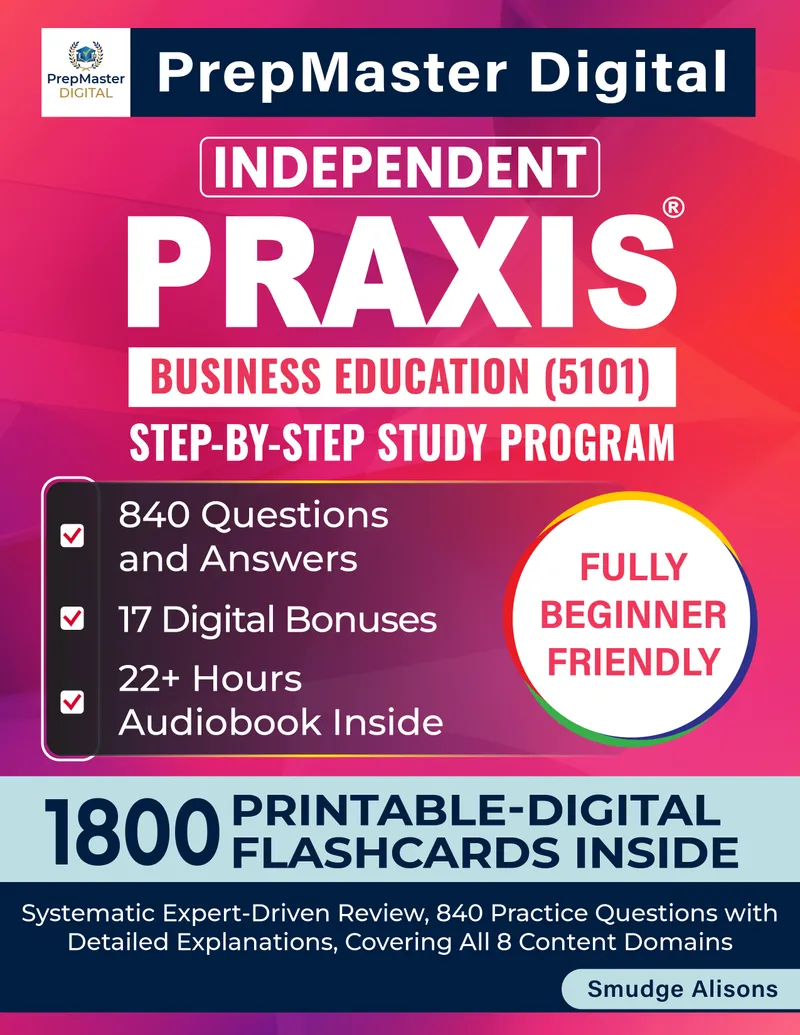
Praxis Business Education (5101) Step-by-Step Study Program Study Guide 2027-2028840 practice questions with explained answers · 1,800 flashcards · 22.1-hour audiobook · AI tutor
Complete digital study edition
Systematic Expert-Driven Review, 840 Practice Questions with Detailed Explanations, Covering All 8 Content Domains
Pass with the PrepMaster Method. Every attempt covered.
Study guide, practice questions with explained answers, flashcards, audiobook, bonuses and an AI tutor. If you don't pass, our Retake Promise gives you the latest edition of everything, free, until you pass.
1. Measure
Take the free readiness test and see where you stand before you study.
2. Study
Work through one complete kit built on your exam's official outline, with the audiobook for the commute.
3. Ask
Stuck on a topic? The AI tutor answers from the chapters of your guide (5 free questions included).
4. Retake Promise
Didn't pass? Send us your official result and we give you everything, updated, free, for your next attempt.
5 sample Praxis Business Education (5101) Step-by-Step Study Program questions from the guide
Taken from the practice tests in the book, with the answer and the explanation the guide gives.
1. A city government sets the maximum monthly rent for apartments below the market equilibrium rent. What is the most likely result?
- A. The apartment market clears at the maximum rent.
- B. A surplus of apartments because landlords supply more than renters demand.
- C. Landlords increase the number of apartments offered for rent.
- D. A shortage of apartments because quantity demanded exceeds quantity supplied.
Show the answer
Correct answer: D. A binding price ceiling sets price below equilibrium, so quantity demanded exceeds quantity supplied, creating a shortage. The market cannot clear at the ceiling price.
2. A company purchases $2,000 of office supplies on account. How does this transaction affect the accounting equation immediately after it is recorded?
- A. Assets decrease by $2,000 and liabilities decrease by $2,000
- B. Assets increase by $2,000 and equity increases by $2,000
- C. Assets increase by $2,000 and liabilities increase by $2,000
- D. No change to total assets or total liabilities
Show the answer
Correct answer: C. Purchasing supplies on account increases the asset Supplies and increases the liability Accounts Payable by the same amount, so total assets and total liabilities both rise by $2,000 and the equation stays in balance. The other choices misstate the direction or the accounts affected.
3. A $5,000 certificate of deposit earns 6% annual interest. How much more interest is earned over two years if interest is compounded annually instead of computed as simple interest?
- A. $18.00
- B. $30.00
- C. $600.00
- D. $618.00
Show the answer
Correct answer: A. Simple interest yields $5,000 x 0.06 x 2 = $600; annual compounding yields $5,000 x (1.06² - 1) = $618. The $18 difference is the interest earned on the first year's $300 of interest.
4. A manufacturer has three departments: engineering, marketing, and finance. Engineers working on the consumer electronics product line and engineers working on the medical devices product line all report to the same engineering director. Marketing and finance employees likewise report to their own department heads. This structure is best described as which type?
- A. Functional
- B. Flat
- C. Matrix
- D. Divisional by product
Show the answer
Correct answer: A. Employees are grouped by specialty, with all engineers reporting to an engineering director, all marketers to a marketing director, and all finance staff to a finance director. This is a functional structure; divisional structures would group employees by product line, and matrix structures would create dual reporting lines.
5. A cereal manufacturer wants to divide the broad breakfast market into smaller groups with shared characteristics. It groups consumers by age, income, education, and family size. Which basis of market segmentation is the company using?
- A. Behavioral segmentation
- B. Geographic segmentation
- C. Demographic segmentation
- D. Psychographic segmentation
Show the answer
Correct answer: C. Age, income, education, and family size are demographic variables, so the company is using demographic segmentation. Geographic, psychographic, and behavioral segmentation rely on different types of variables.
Eight domains. One focused system.
The Praxis 5101 covers a vast sweep of business topics. This one engineers a clear path: systematic review in all domains, then 840 practice questions delivered as 7 full-length tests with detailed explanations.
Everything you get
One purchase unlocks everything below, with no subscription. The only optional extra is the unlimited AI tutor upgrade. Here is exactly what unlocks the moment you buy, and how each part helps you.
840
practice questions — every answer explained
1,800
digital flashcards, ready to drill
~22.1h
of professional audio narration
14
downloadable study tools
Complete audiobook — about 22.1 hours
The entire book, professionally narrated. Stream it in your browser or download the MP3s and study on the commute, at the gym, or on a break — so the material sinks in even when you can't sit down to read.
AI Study Tutor — ask this book anything
A tutor that has read this exact book: ask about any topic, get an answer grounded in its own chapters, right on your access page. 5 questions are included free with your purchase, and the tutor upgrade gives you unlimited questions (fair use: 100 a day — write to us and we lift it).
- “Explain this topic in simple words, with an example.”
- “I got this question wrong: why is the right answer correct?” (paste the question)
- “Which chapter should I review for my weakest topic?”
90-Day Personalized Study Plan & Tracker
A day-by-day schedule that every topic to your available hours, with a progress tracker.
Key Concepts Quick-Reference Cards
Printable cards summarizing the most-tested definitions and formulas in each domain.
Practice Test Performance Analyzer
A table to log your scores by domain, identify weak areas, and target review sessions.
Formula Sheet for Finance and Accounting
All the key equations you need, organized and explained in plain English.
Time Management Strategy Playbook
Pacing techniques for a 2-hour exam, with drills to build speed and accuracy.
Vocabulary Decoder for Business Jargon
Plain-English translations of 200+ terms that often trip up test takers.
Case Study Analysis Framework
A step-by-step method for breaking down any business scenario question.
Mnemonics and Memory Aids Collection
Memory tricks for key concepts, from the accounting cycle to marketing mix.
Weekly Review Checklist
A printable checklist to keep your study sessions on track each week.
Common Mistakes and Pitfalls Guide
A list of frequent errors and how to avoid them, based on expert analysis.
Exam-Day Logistics Checklist
What to bring, what to expect, and how to plan your test center visit.
Answer Explanation Template
A structured format to review each practice question and lock in the reasoning.
Group Study Discussion Prompts
Discussion questions to deepen understanding when studying with peers.
Final Review Sprint Guide
A focused one-week plan to revisit the highest-yield topics before test day.
Delivered as a PDF and EPUB you can read on any device, plus downloadable audio and toolkit files. Nothing to install, and your access never expires.
Everything you'll master, chapter by chapter
The complete syllabus of this guide — built on the official exam outline.
Chapter 1: Orientation, How to Use This Step-by-Step Program for the Praxis 5101
- ▸ The Exam Blueprint, Question Format, Time Limit, and Content Domains
- ▸ Building a Personal Study Schedule with the Step-by-Step Method
- ▸ How to Use Practice Question Explanations to Learn From Mistakes
- ▸ Using the On-Screen Scientific Calculator and Numeric Entry Items
Chapter 2: Economics, Microeconomics, Macroeconomics, and the Global Economy
- ▸ Supply and Demand, Elasticity, Equilibrium, and Price Controls
- ▸ Market Structures and Competitive Behavior
- ▸ Macroeconomic Measures, GDP, Inflation, and Unemployment
- ▸ Fiscal Policy and Monetary Policy Actions
- ▸ Business Cycles, Economic Growth, and Productivity
- ▸ International Trade, Comparative Advantage, Exchange Rates, and the Balance of Payments
Chapter 3: Accounting, Recording Transactions and Preparing Financial Statements
- ▸ The Accounting Equation and Double-Entry Bookkeeping
- ▸ The Accounting Cycle, Journals, Ledgers, and Trial Balance
- ▸ Preparing the Balance Sheet from a Trial Balance
- ▸ Preparing the Income Statement and Statement of Cash Flows
- ▸ Inventory Valuation Methods, FIFO, LIFO, and Weighted-Average
- ▸ Depreciation Methods, Straight-Line, Declining Balance, and Units of Production
Chapter 4: Finance, Capital Budgeting, Securities, and Risk Management
- ▸ Time Value of Money, Present Value, Future Value, and Annuities
- ▸ Capital Budgeting Decisions, NPV, IRR, and Payback Period
- ▸ The Cost of Capital and Capital Structure Choices
- ▸ Stocks, Bonds, and How Securities Markets Work
- ▸ Financial Ratios as Decision-Making Tools
- ▸ Risk, Diversification, and the Role of Insurance
Chapter 5: Management, Leading People and Organizational Systems
- ▸ The Four Management Functions, Planning, Organizing, Leading, and Controlling
- ▸ Organizational Structure Choices, Functional, Divisional, Matrix, and Flat
- ▸ Motivation Theories and Their Workplace Applications
- ▸ Leadership Styles and Situational Leadership
- ▸ Human Resource Management, Recruitment, Training, Evaluation, and Compensation
- ▸ Operations Management, Quality, Supply Chain, and Process Improvement
Chapter 6: Marketing, Strategy, Research, and the Marketing Mix
- ▸ Market Segmentation, Targeting, and Positioning
- ▸ Marketing Research, Methods, Data, and Decisions
- ▸ Product Strategy, Lifecycle, Branding, and Packaging
- ▸ Pricing Strategy and Common Price Adjustment Tactics
- ▸ Distribution Channels and Retailing Decisions
- ▸ Integrated Promotion, Advertising, Public Relations, Sales Promotion, Personal Selling, and Digital
Chapter 7: Entrepreneurship, Opportunity, Planning, and New Venture Growth
- ▸ Opportunity Recognition, Feasibility Analysis, and the Lean Startup
- ▸ Writing a Business Plan, Structure and Investor Expectations
- ▸ Choosing a Legal Structure for a New Business
- ▸ Startup Funding, Personal Savings, Crowdfunding, Angels, and Venture Capital
- ▸ Building a Business Model, Value Proposition, Revenue Streams, and Unit Economics
- ▸ Managing Startup Growth, Pivoting, Scaling, and Exit Options
Chapter 8: Information Technology, Systems, Data, and Cybersecurity for Business
- ▸ Computer Hardware, Software, and Networking Foundations
- ▸ Business Data Management, Databases, Spreadsheets, and Data Visualization
- ▸ Enterprise Systems, ERP, CRM, and E-Commerce Platforms
- ▸ Cybersecurity Threats and Countermeasures
- ▸ Data Governance, Backup, and Disaster Recovery
- ▸ Cloud Computing and Collaboration Technologies
Chapter 9: Law and International Business, Legal Environment and Global Operations
- ▸ Contracts, Formation, Performance, Breach, and Remedies
- ▸ Business Torts, Agency, and Product Liability
- ▸ Intellectual Property, Patents, Trademarks, Copyrights, and Trade Secrets
- ▸ Employment and Labor Law Basics
- ▸ Antitrust, Consumer Protection, and Securities Regulation
- ▸ International Market Entry, Cultural Differences, and Political Risk
- ▸ International Trade Agreements, Tariffs, and Global Economic Organizations
Chapter 10: Communication and Career Development, Professional Skills and Workplace Dynamics
- ▸ The Communication Process, Verbal, Nonverbal, and Active Listening
- ▸ Business Writing, Memos, Email, Reports, and Proposals
- ▸ Presentations and Public Speaking in Professional Settings
- ▸ Interpersonal Communication, Teamwork, and Conflict Resolution
- ▸ Career Planning, Resumes, Cover Letters, and Interview Preparation
- ▸ Professional Etiquette, Ethics, and Workplace Relationships
Chapter 11: Professional Business Education, Curriculum, Instruction, and Assessment
- ▸ Designing a Business Education Curriculum Aligned to Standards
- ▸ Instructional Strategies, Project-Based Learning, Simulations, and Work-Based Learning
- ▸ Using Educational Technology in the Business Classroom
- ▸ Assessing Student Learning, Formative and Summative Approaches
- ▸ Classroom Management and Career and Technical Student Organizations
- ▸ Building Business Education Programs and Industry Partnerships
Chapter 12: Test-Taking Strategy and Final Review Plan
- ▸ Pacing Strategies for a Two-Hour Computer-Delivered Exam
- ▸ Approaching Selected-Response and Numeric Entry Questions
- ▸ Using Your Remaining Study Time to Fix Content Gaps
- ▸ Exam-Day Logistics and Mental Preparation
…plus the full-length practice exams with every answer explained.
How you get everything
No accounts to create, no waiting. Here is exactly what happens after you buy.
Buy securely
Checkout is handled by our payment provider over an encrypted connection. Pay by card in about a minute.
Get an instant email
Seconds after payment, we email you a private access link — no app to download, no signup to complete.
Open everything
Your access page unlocks the full digital edition, audiobook and toolkit. It is yours to keep, with lifetime access.
Retake Promise: you never pay twice
If you don't pass, tell us: we give you the newest edition of everything (the guide, practice questions, flashcards, audiobook, bonuses and the AI tutor), free, for every new attempt until you pass. We also let you know when new editions and new exam guides come out, and you get a personal 50% code on all our other guides to prepare for your next exam. Full terms.
Common questions
Is this an official exam product?
No — this is an independent study guide created to help you prepare. It isn't affiliated with or endorsed by the organization that administers the exam. All names and trademarks belong to their respective owners.
How do I get access after buying?
Immediately. Your private access link arrives by email within seconds of checkout, and it never expires.
What format is everything in?
You get the full guide as a PDF and EPUB, the audiobook as downloadable MP3s, and every study tool as a ready-to-use file. Nothing to install.
What's the difference between the digital and paperback edition?
Same complete guide. The digital edition gives you instant access right here plus the full toolkit. The Amazon paperback ships to you and unlocks the same toolkit with the code printed inside.
Can I get a refund?
Digital guides are delivered instantly, so we don't offer refunds. Instead there is the Retake Promise: if you don't pass, you get everything, updated, free, until you pass, and a personal 50% code on our other guides. Before you buy, try the free readiness test. Full terms of the Retake Promise. Your legal rights are not affected (refund policy).
Walk in prepared. Start today.
The complete guide, the practice questions, the audiobook and the full toolkit — unlocked the moment you buy, and yours to keep.
Already own the book? Redeem your code →
PrepMaster Digital is an independent publisher. This guide is not affiliated with or endorsed by the organization that administers the exam. All exam names and trademarks belong to their owners.
$66.99$19.99instant access