
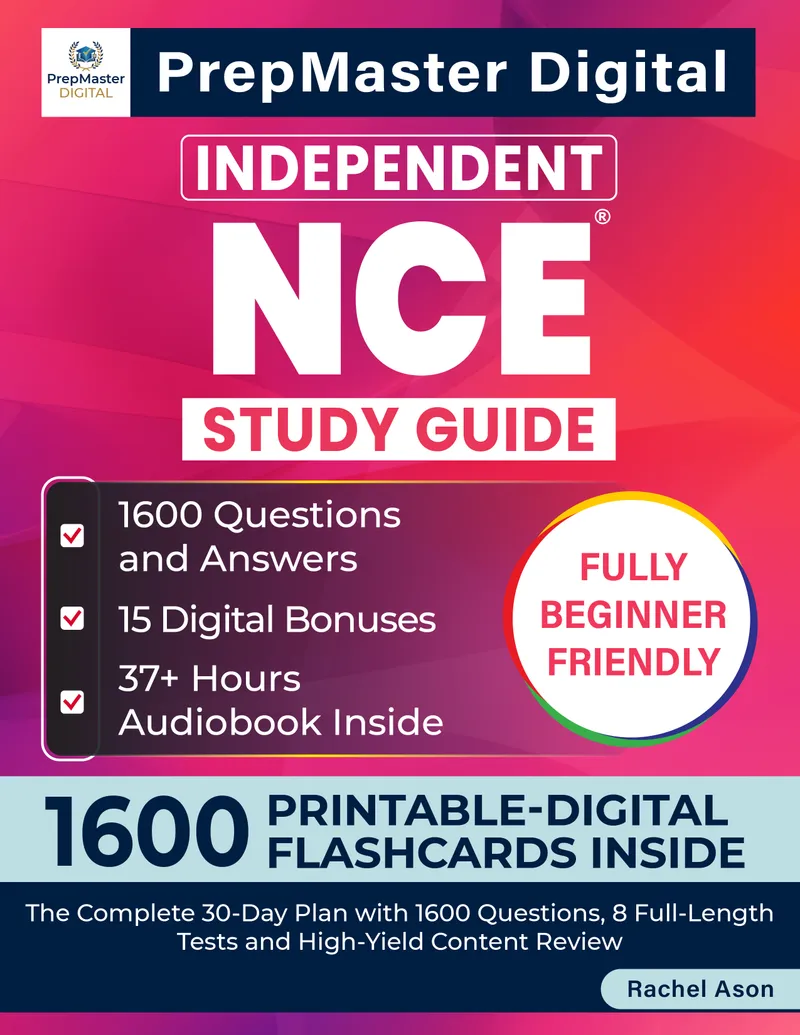
NCE Study Guide 2027-20281,600 practice questions with explained answers · 1,600 flashcards · 37.9-hour audiobook · AI tutor
Complete digital study edition
The Complete 30-Day Plan with 1600 Questions, 8 Full-Length Tests and High-Yield Content Review
Pass with the PrepMaster Method. Every attempt covered.
Study guide, practice questions with explained answers, flashcards, audiobook, bonuses and an AI tutor. If you don't pass, our Retake Promise gives you the latest edition of everything, free, until you pass.
1. Measure
Take the free readiness test and see where you stand before you study.
2. Study
Work through one complete kit built on your exam's official outline, with the audiobook for the commute.
3. Ask
Stuck on a topic? The AI tutor answers from the chapters of your guide (5 free questions included).
4. Retake Promise
Didn't pass? Send us your official result and we give you everything, updated, free, for your next attempt.
5 sample NCE questions from the guide
Taken from the practice tests in the book, with the answer and the explanation the guide gives.
1. A counselor who works in a school observes that a nine-year-old student has multiple bruises that appear hand-shaped and gives contradictory explanations for how they occurred. The counselor suspects physical abuse but has no proof. Which threshold should guide the counselor's report to child protective services?
- A. A medical examiner's confirmation that the bruises were inflicted non-accidentally.
- B. Reasonable suspicion that abuse has occurred.
- C. A direct, spontaneous statement by the child naming the abuser.
- D. Certainty that abuse occurred, because false reports can be punished.
Show the answer
Correct answer: B. Mandatory child abuse reporting statutes require a report when a counselor has reasonable suspicion that a child has been abused or neglected. Proof, medical confirmation, or a child's direct statement is not required to trigger the reporting duty.
2. A client tells a counselor, "Sometimes I think about going to sleep and not waking up." Using the standard risk assessment sequence, which question should the counselor ask next?
- A. Have you thought about how you would do it?
- B. What would stop you from acting on that thought?
- C. On a scale of zero to ten, how strong is the urge right now?
- D. Have you ever attempted suicide before?
Show the answer
Correct answer: A. After suicidal ideation is endorsed, the standard risk assessment sequence moves to plan status before assessing means, intent, history, or protective factors. Asking directly about a method of suicide determines whether a plan exists, whereas the alternatives address later elements in the sequence.
3. A counselor wants to know whether an 8-year-old's repeated morning school refusal is a specific, school-linked fear or a broader anxiety pattern. Which plan provides the most useful assessment data?
- A. Ask the parents to record each morning's refusal intensity on a 1 to 10 scale for two weeks, noting what happened just before it
- B. Meet weekly with the child and ask open-ended questions about feelings
- C. Ask the school to administer a group anxiety questionnaire to the entire class
- D. Begin a reward system for attendance and observe whether the behavior improves
Show the answer
Correct answer: A. Frequent, structured parent ratings of refusal intensity and antecedents yield baseline data that can reveal whether avoidance is specific to school or occurring across settings. Unstructured interviews and trial interventions are less reliable for that initial distinction.
4. A client with high suicide risk has a specific plan, immediate access to the means, and says the attempt may happen tonight. Which response best follows the high risk protocol?
- A. Arrange emergency evaluation now, which may mean going to an emergency department or calling emergency services if needed.
- B. Contact a family member to remove the means and ask the client to call if thoughts worsen.
- C. Schedule a follow-up appointment for tomorrow morning after asking the client to remain safe.
- D. Ask the client to sign a no-suicide contract as the sole protective intervention.
Show the answer
Correct answer: A. High risk with a specific plan, immediate means, and a stated time frame requires emergency evaluation. A later appointment, a family member alone, or a no-suicide contract is not a sufficient response.
5. Which scenario best illustrates an enmeshed boundary in a family?
- A. Family members seldom ask about one another's feelings and prefer to work through problems by themselves.
- B. A teenager asks her parents' permission before going out, and they negotiate a curfew together.
- C. After an argument, the parents wait until the children are asleep to discuss the disagreement privately.
- D. A mother tells her 12-year-old daughter every detail of her marital fights and expects the daughter to comfort her, leaving the daughter little private emotional life.
Show the answer
Correct answer: D. An enmeshed boundary means overinvolvement, blurred roles, and little privacy between members. Treating a child as a confidante for adult marital distress collapses the parental hierarchy into a peer-like bond.
More study time does not equal a higher score.
Endless rereading of dense textbooks drains your energy without moving the needle. This guide flips the equation: a focused review of the high-yield material, then 1,600 practice questions that show you exactly how the exam thinks. You train the way the test is written, so every hour you spend counts double.
Everything you get
One purchase unlocks everything below, with no subscription. The only optional extra is the unlimited AI tutor upgrade. Here is exactly what unlocks the moment you buy, and how each part helps you.
1,600
practice questions — every answer explained
1,600
digital flashcards, ready to drill
~37.9h
of professional audio narration
12
downloadable study tools
Complete audiobook — about 37.9 hours
The entire book, professionally narrated. Stream it in your browser or download the MP3s and study on the commute, at the gym, or on a break — so the material sinks in even when you can't sit down to read.
AI Study Tutor — ask this book anything
A tutor that has read this exact book: ask about any topic, get an answer grounded in its own chapters, right on your access page. 5 questions are included free with your purchase, and the tutor upgrade gives you unlimited questions (fair use: 100 a day — write to us and we lift it).
- “Explain this topic in simple words, with an example.”
- “I got this question wrong: why is the right answer correct?” (paste the question)
- “Which chapter should I review for my weakest topic?”
30-Day Study Calendar (Printable Tracker)
Each day's review, practice test and rest period to stay on schedule.
High-Yield Topic Checklist
Tick off every domain and subdomain you've mastered, spot gaps at a glance.
Answer Rationale Decoder
Learn to break down any rationale into the core concept, the distractors, and the takeaway.
Ethics Scenarios Scriptbook
Role-play common ethical dilemmas with scripted responses to internalize the right call.
DSM-5 Quick Reference Card
Carry the key diagnostic criteria and specifiers in a one-page cheat sheet.
Counseling Theories Comparison Chart
See each major theory's view of human nature, goals, and techniques side by side.
Test-Day Survival Kit
A printable checklist of what to bring, what to expect, and how to pace yourself.
Group Work Cheat Sheet
Master stages of group development, leadership styles, and therapeutic factors fast.
Career Counseling Resource Directory
Find the key assessments, theories, and occupational databases in one organized list.
Research & Statistics Formula Card
Keep every formula and concept you need for research methods and stats close at hand.
Supervision Log Template
Track your supervised hours and reflective notes in a structured, print-ready format.
Anxiety Management Playbook
Practical, evidence-based techniques to stay calm and focused during study and on test day.
Delivered as a PDF and EPUB you can read on any device, plus downloadable audio and toolkit files. Nothing to install, and your access never expires.
Everything you'll master, chapter by chapter
The complete syllabus of this guide — built on the official exam outline.
Chapter 1: Your 30-Day Operating System, How to Use This Book
- ▸ Three Phases of the 30-Day Plan, Foundation, Integration, and Calibration
- ▸ How to Run a Chapter Study Session in 30 to 60 Minutes
- ▸ Keeping a Simple Progress Log Without Letting It Become Homework
- ▸ Using Practice Exam Results to Reset Your Week
Chapter 2: Test Mechanics and Study Strategies for NCE Multiple Choice
- ▸ Anatomy of a Multiple-Choice Question, What the Writer Is Really Asking
- ▸ The Two-Pass Method and the Per-Question Budget
- ▸ Retrieval Practice, Spacing, and Interleaving, Memory That Lasts
- ▸ When Every Answer Looks Right, Choosing by Ethical and Clinical Priority
- ▸ Steadying Attention and Arousal During Long Testing Blocks
Chapter 3: Professional Practice and Ethics, Laws, Codes, and Decision-Making
- ▸ Where Ethics Come From, The ACA Code, the NBCC Code, and State Law
- ▸ Informed Consent and Confidentiality, Promises You Can and Cannot Make
- ▸ Dual and Multiple Relationship Rules, Evaluating Risk, Power, and Harm
- ▸ Duty to Protect, Duty to Warn, and Reporting Statutes
- ▸ Ethics in Records, Technology, Social Media, and Billing
- ▸ Supervision, Consultation, and Personal Competence
- ▸ An Ethical Decision-Making Model for Complex Cases
Chapter 4: Intake, Assessment, and Diagnosis, From First Contact to Case Formulation
- ▸ Structuring the Intake Interview, Opening Questions, Critical Follow-Up, and Closing
- ▸ The Mental Status Examination, Observable Domains and Recording Language
- ▸ Choosing Assessment Instruments, When to Screen, When to Test, and When to Refer
- ▸ Diagnostic Reasoning With DSM-5-TR, Ruling Out, Ruling In, and Specifiers
- ▸ Cultural, Linguistic, and Identity Contexts in Test Interpretation
- ▸ Writing a Case Formulation That Connects Presenting Facts to Direction
Chapter 5: Areas of Clinical Focus I, Human Development and Life Transitions
- ▸ Using Developmental Theory as a Framework for Client Concerns
- ▸ Helping Children and Adolescents Navigate School, Identity, and Family Change
- ▸ Emerging Adult Transitions, Independence, Intimacy, and Life Purpose
- ▸ Midlife Tasks, Caregiving, Generativity, Work, and Role Demands
- ▸ Later-Life Transitions, Autonomy, Loss, and New Sources of Strength
Chapter 6: Areas of Clinical Focus II, Crisis, Trauma, Abuse, and Addiction
- ▸ Crisis Triage, Suicide, Homicide, and Severe Disorganization
- ▸ Trauma Responses and the Phase-Based Treatment Route
- ▸ Abuse and Interpersonal Violence, Recognition, Safety Planning, and Empowerment
- ▸ Substance Use and Process Addictions, Assessment and Level-of-Care Decisions
- ▸ Co-Occurring Substance and Mental Health Presentations
- ▸ Grief and Traumatic Loss, Distinguishing Normal and Complicated Responses
Chapter 7: Areas of Clinical Focus III, Couples, Family, Group, and Career Counseling
- ▸ Couples Counseling, Interaction Cycles, Attachment, and Repair Attempts
- ▸ Family Counseling, Boundaries, Triangles, and the Family Life Cycle
- ▸ Divorce, Blended Families, and Parenting Coordination
- ▸ Career Counseling, Work Roles, Values, and Transitions Across Life
- ▸ Group Counseling, Selecting Members, Managing Stages, and Handling Process
- ▸ Community and Wrap-Around Practice, Coordinating Care Beyond the Individual
Chapter 8: Treatment Planning, Goals, Interventions, and Outcome Monitoring
- ▸ From Case Formulation to a Working Problem List
- ▸ Building Person-Centered Treatment Goals and Measurable Objectives
- ▸ Choosing Interventions and Explaining the Rationale to Clients
- ▸ Drafting the Written Treatment Plan, Format, Frequency, and Review Milestones
- ▸ Coordinating With Other Providers and Deciding When to Refer
- ▸ Planning for Termination, Setbacks, and Long-Term Maintenance
Chapter 9: Counseling Skills and Interventions I, The Helping Relationship and Core Process
- ▸ The Shape of a Session, Opening, Check-In, Working Time, and Closing
- ▸ Listening as Intervention, Paraphrase, Reflection, and Summarizing
- ▸ Clarifying Meaning and Feeling, Advanced Empathy in Action
- ▸ Immediacy and Self-Disclosure, When the Relationship Becomes the Topic
- ▸ Confrontation, Feedback, and Repair After a Relational Rupture
- ▸ Working With Silence, Resistance, and Strong Client Affect
Chapter 10: Counseling Skills and Interventions II, Evidence-Based Techniques and Theoretical Models
- ▸ Cognitive-Behavioral Interventions, Cognitive Restructuring, Activity, and Graded Tasks
- ▸ Motivational Interviewing, Evoking and Strengthening Change Talk
- ▸ Mindfulness and Acceptance-Based Methods in Counseling
- ▸ Solution-Focused and Strengths-Based Questioning in Brief Work
- ▸ Existential and Interpersonal Pattern Work, Meaning, Choice, and Agency
- ▸ Building a Personal Technique Library, Matching Method to Client and Stage
Chapter 11: Core Counseling Attributes, Authenticity, Cultural Humility, and Professional Identity
- ▸ Self-Awareness, Triggered Reactions, and Countertransference Management
- ▸ Empathy, Positive Regard, and Congruence as Living Attributes
- ▸ Cultural Humility and the Willingness to Learn From the Client
- ▸ Religious, Spiritual, and Philosophical Difference in the Counseling Relationship
- ▸ Developing a Personal Counseling Theory and Professional Identity
Chapter 12: The Last Seven Days, Consolidation, Rehearsal, and Test-Day Logistics
- ▸ What to Consolidate and What to Set Aside in the Final Week
- ▸ Running a Full-Length Rehearsal, Rules, Timing, and Review Procedure
- ▸ The First Portion of Test Day, Nondisclosure, Tutorial, and Starting Your Clock
- ▸ Monitoring Attention, Energy, and Time Across the Whole Testing Window
- ▸ The Ride Home, Separating the Exam Experience From Your Self-Worth
…plus the full-length practice exams with every answer explained.
How you get everything
No accounts to create, no waiting. Here is exactly what happens after you buy.
Buy securely
Checkout is handled by our payment provider over an encrypted connection. Pay by card in about a minute.
Get an instant email
Seconds after payment, we email you a private access link — no app to download, no signup to complete.
Open everything
Your access page unlocks the full digital edition, audiobook and toolkit. It is yours to keep, with lifetime access.
Retake Promise: you never pay twice
If you don't pass, tell us: we give you the newest edition of everything (the guide, practice questions, flashcards, audiobook, bonuses and the AI tutor), free, for every new attempt until you pass. We also let you know when new editions and new exam guides come out, and you get a personal 50% code on all our other guides to prepare for your next exam. Full terms.
Common questions
Is this an official exam product?
No — this is an independent study guide created to help you prepare. It isn't affiliated with or endorsed by the organization that administers the exam. All names and trademarks belong to their respective owners.
How do I get access after buying?
Immediately. Your private access link arrives by email within seconds of checkout, and it never expires.
What format is everything in?
You get the full guide as a PDF and EPUB, the audiobook as downloadable MP3s, and every study tool as a ready-to-use file. Nothing to install.
What's the difference between the digital and paperback edition?
Same complete guide. The digital edition gives you instant access right here plus the full toolkit. The Amazon paperback ships to you and unlocks the same toolkit with the code printed inside.
Can I get a refund?
Digital guides are delivered instantly, so we don't offer refunds. Instead there is the Retake Promise: if you don't pass, you get everything, updated, free, until you pass, and a personal 50% code on our other guides. Before you buy, try the free readiness test. Full terms of the Retake Promise. Your legal rights are not affected (refund policy).
Walk in prepared. Start today.
The complete guide, the practice questions, the audiobook and the full toolkit — unlocked the moment you buy, and yours to keep.
Already own the book? Redeem your code →
PrepMaster Digital is an independent publisher. This guide is not affiliated with or endorsed by the organization that administers the exam. All exam names and trademarks belong to their owners.
$66.99$19.99instant access